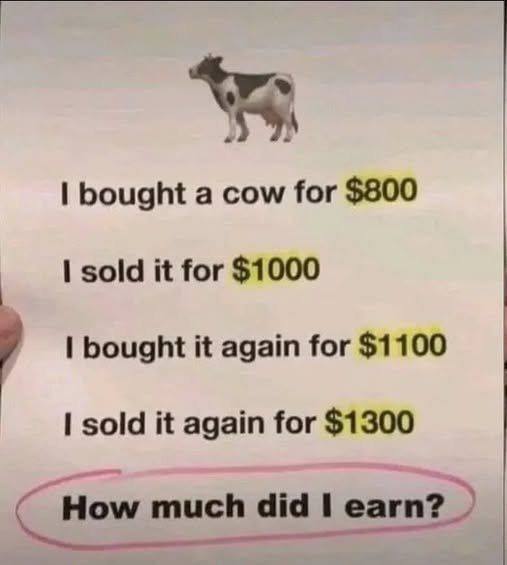
It sounds simple at first: a man buys a cow for $800, sells it for $1,000, buys it again for $1,100, and sells it again for $1,300.
Four numbers. Two purchases. Two sales.
No hidden fees. No taxes. No loans. No tricks in the wording.
And yet, somehow, this tiny cow puzzle has confused thousands of people online.
At first glance, many people feel confident they know the answer immediately. Some say he made nothing. Others say he made only $200. A few insist the second purchase cancels out the first sale, leaving no real profit at all. The debate often becomes surprisingly heated, not because the math is complicated, but because the sequence makes the brain uncomfortable.
The trap is not in the numbers.
The trap is in trying to hold the entire story in your head at once.
When people see the same cow being bought, sold, bought again, and sold again, they often start treating the transactions like one tangled loop. Instead of separating each deal, they mentally combine everything into one confusing event. That is where the wrong answers usually begin.
But the puzzle becomes clear the moment you slow it down.
The first transaction is simple.
He buys the cow for $800.
Then he sells it for $1,000.
That means he made a profit of $200.
So far, there is no mystery.
Then comes the second transaction.
He buys the cow again, this time for $1,100.
Then he sells it again for $1,300.
Once again, he makes a profit of $200.
Now add both profits together.
$200 from the first deal plus $200 from the second deal equals $400.
That is the final answer.
He made $400 profit.
Another way to check it is to zoom out and look at the total money going out and the total money coming in.
He spent $800 the first time and $1,100 the second time. That means he spent a total of $1,900.
He received $1,000 from the first sale and $1,300 from the second sale. That means he received a total of $2,300.
Now subtract what he spent from what he earned.
$2,300 minus $1,900 equals $400.
Same answer.
The man made $400.
What makes this puzzle interesting is not really the cow or even the money. It is the way people react to it. A problem that can be solved with basic subtraction suddenly becomes a battle of confidence. People who normally understand simple math begin second-guessing themselves because the story feels like it should contain a trick.
That expectation becomes the real trick.
We are so used to riddles hiding something clever that we sometimes invent complications that are not there. We assume the second purchase must erase the first profit. We imagine the cow’s value somehow matters. We focus on the fact that he bought the same cow again instead of treating each exchange as a separate deal.
But business does not work that way.
Each completed buy-and-sell creates its own result. If you buy something for less and sell it for more, you make profit. If you do that twice, you add the two profits together.
The cow being the same animal does not change the math.
The first time, he made $200.
The second time, he made $200.
Together, he made $400.
The reason so many people answer $200 is that they only focus on the difference between the first buying price and the last selling price, or they accidentally ignore one of the completed trades. Others answer $0 because they think buying it back at a higher price somehow wipes away the earlier gain. But once the first sale happens, that $200 profit has already been made. The second deal is a new decision with its own cost and return.
This is why slowing down matters.
When you separate the story into smaller parts, the confusion disappears almost instantly. The puzzle stops feeling like a riddle and starts looking like exactly what it is: two profitable transactions.
And that is the real lesson hidden inside this simple cow problem.
Sometimes the biggest mistakes do not happen because something is too hard. They happen because we rush. We try to compress several steps into one mental shortcut. We trust our first reaction before checking the structure. Then, once we choose an answer, we defend it with confidence even if the numbers do not support it.
In that sense, the cow puzzle is less about arithmetic and more about clear thinking.
It reminds us that confidence is not the same as accuracy. A person can be completely sure and still be wrong if they skipped steps. On the other hand, a calm person who breaks the problem down carefully can solve it without stress.
The answer is not hidden.
It is simply waiting for you to slow down enough to see it.
He bought for $800 and sold for $1,000: $200 profit.
He bought for $1,100 and sold for $1,300: another $200 profit.
Total profit: $400.
Simple, clean, and surprisingly easy to overthink.
 admin
admin