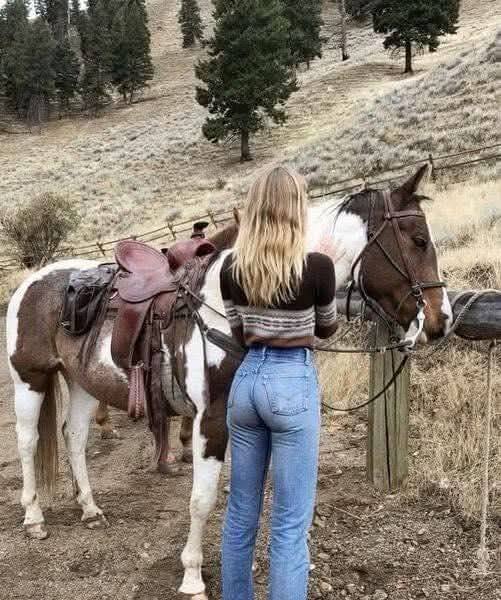
The photograph lasted less than a second.
The damage lasted much longer.
At the time, it felt harmless — almost forgettable. A quiet moment during a trail ride, sunlight filtering through the trees, the steady rhythm of the horse beneath her, and the rare feeling that life had slowed down enough for her to breathe properly again.
She hadn’t posted the picture to provoke anyone.
Hadn’t studied it for hidden meanings.
Hadn’t imagined that a small detail buried in the corner of the frame would eventually become more important than the memory itself.
To her, the photo was simple.
A gesture.
A small way of saying:
“I’m okay.”
“I thought of you.”
“I wanted to share this moment with someone I love.”
That was all.
But relationships rarely unravel because of what people intend.
More often, they unravel because of what other people fear.
At first, he barely reacted when she sent the picture. A quick response. Nothing unusual. But later that evening, something shifted. He reopened the image. Zoomed in. Stared longer.
Then he saw the initials.
A.M.
Carved faintly into the leather saddle.
Insignificant to her.
Instantly enormous to him.
The problem with insecurity is that once it attaches itself to something, logic stops functioning normally. A detail that could have been meaningless suddenly transforms into evidence. Questions begin multiplying faster than answers can calm them.
Who was A.M.?
Why hadn’t she mentioned it?
Had the saddle belonged to someone from her past?
Was the ride really innocent?
The human mind is disturbingly talented at building entire emotional realities from fragments.
And once suspicion enters a relationship, even silence starts sounding guilty.
She explained immediately.
The initials meant nothing to her. She hadn’t noticed them before sending the photo. The horse wasn’t hers. The saddle likely belonged to the ranch, another rider, maybe someone she would never even meet.
But by then, the conversation had already changed shape.
What she believed was reassurance sounded to him like defense.
What she experienced as honesty sounded to him like careful wording.
That is the frightening thing about mistrust once it begins growing quietly inside love: explanations stop feeling like truth and start feeling like strategy.
And from that moment forward, something subtle shifted between them.
Not dramatically.
There was no explosive breakup. No screaming argument. No betrayal anyone could clearly point to later.
Instead, distance arrived quietly.
The most dangerous kind.
The kind that settles invisibly into ordinary conversations until even harmless moments begin carrying tension underneath them. A delayed text suddenly feels suspicious. A forgotten detail feels intentional. Innocent gestures become emotionally cross-examined for hidden meaning.
Love becomes investigation instead of connection.
And investigations rarely end peacefully when one person is searching for proof rather than understanding.
Over time, she realized the photograph itself had never actually been the issue.
Not really.
The initials were simply the spark that exposed something already waiting beneath the surface: fear.
Fear of abandonment.
Fear of replacement.
Fear that love might not be as secure as it once felt.
Those fears rarely announce themselves directly. Instead, they disguise themselves as vigilance, questions, caution, or “gut feelings.” People convince themselves they are protecting the relationship while unknowingly poisoning the trust holding it together.
And trust is fragile in a very specific way.
Once someone begins assuming hidden meaning exists everywhere, reality itself starts becoming difficult to recognize clearly. Neutral events feel loaded. Coincidences feel intentional. Imagination outruns evidence.
Eventually, the relationship stopped feeling emotionally safe for either of them.
She became exhausted trying to prove innocence for things she never considered suspicious in the first place. He became exhausted trying to silence fears that never fully disappeared no matter how many explanations she offered.
That exhaustion changed them both.
Because constant doubt slowly reshapes how people love.
One person starts shrinking themselves to avoid triggering suspicion.
The other starts watching for pain even where none exists.
And somewhere inside that cycle, tenderness disappears quietly.
Looking back later, she would understand something painful but important:
The fracture was never really about the saddle.
Or the initials.
Or even the possibility of another person.
It was about how quickly imagination became more believable than trust.
How easily fear rewrote reality.
And how dangerous it becomes when someone starts believing the stories inside their head more than the person standing in front of them.
Love survives mistakes surprisingly often.
What it struggles to survive is interpretation without grace.
Because once every action becomes potential evidence, intimacy starts dying under the weight of constant suspicion. No relationship can breathe normally when every gesture risks becoming a trial.
In the end, the saddest part wasn’t that he misunderstood the photo.
It was that she eventually realized he no longer believed peace was possible without certainty.
And certainty is something no human being can fully give another.
At some point, love requires a choice:
To trust the person you care about more than the fear trying to rewrite them.
Otherwise, even the smallest details — two faded initials on an old saddle — can become powerful enough to destroy something that was never actually threatened in the first place.
 admin
admin