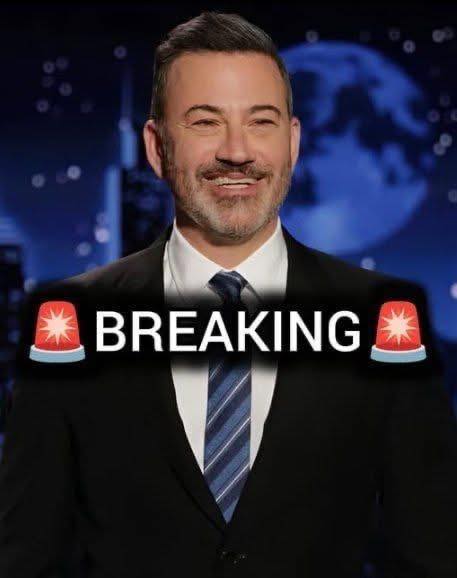
The joke hit the room with the force of a cheap laugh and a dangerous aftertaste. When Jimmy Kimmel referred to Melania Trump as an “expectant widow” during an episode of Jimmy Kimmel Live!, the audience reacted the way late-night audiences often do — with applause, nervous laughter, and the understanding that outrage is now part of the entertainment cycle. At the time, it seemed destined to become just another fleeting political controversy swallowed by the endless churn of social media outrage.
Then, two days later, gunfire erupted near an event attended by Donald Trump.
Suddenly, the joke no longer sounded like satire to millions of Americans. It sounded prophetic. Or reckless. Or unforgivable.
Within hours, clips of Kimmel’s monologue flooded every platform online. The phrase “expectant widow” spread with terrifying speed, detached from context and amplified by fear. Supporters of Trump accused Kimmel of crossing a moral line that should never be approached, let alone televised. Commentators demanded consequences. Some called for advertisers to abandon the show. Others demanded ABC executives publicly condemn the remark or remove Kimmel entirely.
At the center of the storm stood Melania Trump herself.
For days, she remained silent publicly while speculation exploded around her family and the incident in Washington. Then came the statement that transformed the controversy into something much larger than a feud between a comedian and a political family.
Melania condemned the joke as “hateful rhetoric” and questioned how entertainment culture had reached a point where references to death involving public figures could be dismissed as comedy. According to people close to her, she viewed the timing not as unfortunate coincidence but as evidence of a broader climate of hostility that has consumed American public life.
Donald Trump’s response was even more explosive.
The former president accused Kimmel and major television networks of normalizing cruelty against conservatives while hiding behind the shield of comedy. He argued that the media routinely minimizes attacks aimed at his family while demanding outrage for similar rhetoric directed elsewhere. His supporters echoed those arguments across television and online platforms, insisting that words spoken by influential public figures carry consequences far beyond a studio audience.
The pressure on Kimmel intensified by the hour.
Then came the moment everyone waited for: his response on live television.
When the cameras rolled, viewers expected either a full apology or open defiance. Instead, Kimmel attempted something far more dangerous in today’s America — nuance.
He admitted the timing of the joke had become horrifying in hindsight. He acknowledged that hearing the clip after the security scare made even him uncomfortable. But he firmly rejected the idea that his words encouraged violence or should be interpreted as support for harm against Donald Trump or his family.
Kimmel argued the joke was aimed at power, celebrity culture, and public perception — not death.
He reminded viewers that throughout his career he has repeatedly condemned political violence and criticized America’s obsession with guns. He insisted that blaming a comedian for the actions of unstable individuals represented a dangerous misunderstanding of both comedy and accountability.
But he didn’t stop there.
Rather than retreat completely, Kimmel turned the spotlight back toward Trump himself. He accused the former president of spending years fueling division through insults, humiliation, and inflammatory rhetoric directed at opponents, journalists, immigrants, and critics. According to Kimmel, the outrage aimed at one late-night joke ignored a much larger culture of hostility that had already become normalized in American politics long before his monologue aired.
That argument only deepened the divide.
To critics, Kimmel sounded arrogant and unwilling to take responsibility during a moment of national tension. To supporters, he sounded like one of the few public figures refusing to surrender artistic freedom under political pressure.
The deeper issue, however, was bigger than either man.
What unsettled Americans most was not simply the joke itself, but the terrifying collapse of distance between entertainment and reality. The country once treated political satire as exaggerated theater — sharp, offensive, sometimes cruel, but ultimately understood as performance. Now, after years of assassination fears, threats, shootings, and growing extremism, many people no longer know where the performance ends.
That uncertainty lingered over every discussion that followed.
Melania Trump’s visible fear felt real.
Donald Trump’s fury felt real.
Jimmy Kimmel’s defensiveness felt real.
Even the audience’s discomfort felt real.
And that is precisely what made the controversy so explosive. Everyone involved believed they were responding to genuine danger, genuine cruelty, or genuine injustice. Yet each side spoke an entirely different emotional language, incapable of hearing the other without immediately assuming bad faith.
For some Americans, the scandal proved that modern comedy has become too reckless and detached from consequences. For others, it proved that outrage itself has become weaponized to silence criticism and satire.
Meanwhile, ordinary viewers were left confronting a more unsettling question.
What happens when words begin to echo like gunshots?
Not literally. Not directly. But emotionally.
What happens when political jokes no longer feel distant from violence because the country itself feels permanently on edge? When every insult, every monologue, every social media post carries the potential to ignite something larger?
That question now hangs over American discourse like smoke after an explosion.
And perhaps the most disturbing part is that nobody seems to agree on who should lower their voice first.
 admin
admin