What began as a series of immigration enforcement actions has rapidly escalated into one of the most intense federal-state confrontations in recent American history. The situation in Los Angeles has drawn national attention, not only because of the unrest on the streets, but because of the deeper constitutional questions now unfolding at the highest levels of government.
At the center of the crisis is Donald Trump, who, after returning to office, authorized a sweeping federal response to growing protests triggered by large-scale immigration raids conducted by Immigration and Customs Enforcement (ICE). These operations, concentrated in predominantly Latino neighborhoods, ignited immediate backlash, with residents and activists taking to the streets in protest.
Initially peaceful, the demonstrations quickly intensified. Reports of looting, arson, and widespread arrests transformed the situation from civil unrest into what many are now calling a full-scale urban crisis. As images and videos flooded social media, pressure mounted on both state and federal leaders to restore order — but how that should be done became the core of the conflict.
President Trump responded decisively, deploying 2,000 National Guard troops on June 7. However, what made this move particularly controversial was the decision to bypass state authority. Traditionally, National Guard deployments within a state are coordinated with — or requested by — the state’s governor. In this case, Gavin Newsom publicly opposed the action, calling it unlawful and accusing the federal government of escalating tensions rather than calming them.
The disagreement quickly turned into a high-stakes political and legal battle.
Rather than stepping back, the federal response intensified. Troop numbers were doubled, and an additional 700 Marines were authorized for deployment. This marked a significant escalation, raising immediate concerns among legal experts about the boundaries of federal authority — particularly under the Posse Comitatus Act.
The Posse Comitatus Act, a cornerstone of American legal tradition, generally prohibits the use of federal military forces in domestic law enforcement roles. Its purpose is to maintain a clear separation between civilian governance and military power. The presence of Marines in a domestic unrest scenario has therefore triggered widespread debate about whether the administration is pushing those boundaries — or potentially crossing them.
Supporters of the president argue that extraordinary circumstances require strong action. They point to the scale of the unrest and the need to protect property, enforce federal law, and maintain national stability. Critics, however, see the situation very differently. They warn that such moves risk setting a dangerous precedent, where federal power overrides state authority and military force becomes a tool for managing civilian disputes.
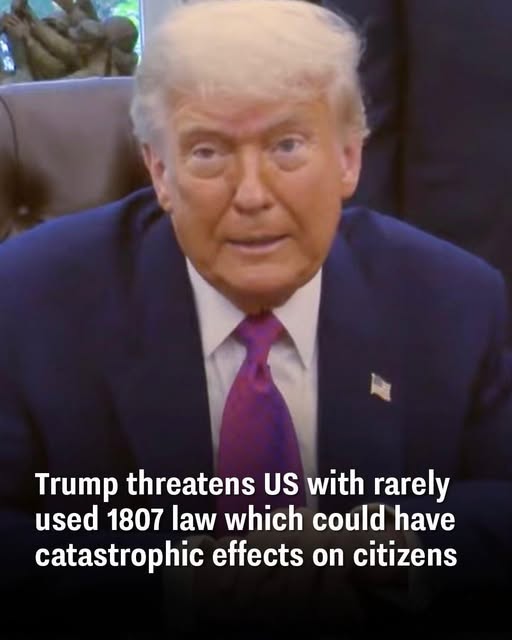
Amid this tension, attention has now turned to another powerful — and rarely invoked — legal mechanism: the Insurrection Act. If invoked, it would allow the president to use active-duty military forces for direct law enforcement within the United States, effectively bypassing many of the restrictions imposed by the Posse Comitatus Act.
The possibility of this step has alarmed legal scholars and civil rights advocates alike.
They argue that invoking the Insurrection Act would mark a dramatic shift in how domestic unrest is handled, potentially blurring the line between military and civilian authority in ways that could have long-term consequences for American democracy. Others counter that the law exists precisely for moments like this — when local authorities are either unable or unwilling to restore order.
Beyond the legal debate, the human impact remains significant. Communities in Los Angeles are grappling not only with the immediate effects of unrest, but also with fear, uncertainty, and division. For many residents, the situation feels deeply personal — tied to issues of identity, immigration, and trust in government institutions.
What makes this moment particularly critical is that it goes beyond a single city or event.
It is, at its core, a test of the balance of power in the United States — between federal authority and state rights, between security and civil liberties, and between political leadership and public trust. The decisions made in the coming days could shape not only the outcome of this crisis, but also the framework for how similar situations are handled in the future.
For now, the nation watches closely.
Because what happens next may redefine the limits of presidential power in ways that will be felt long after the streets of Los Angeles grow quiet again.
 admin
admin