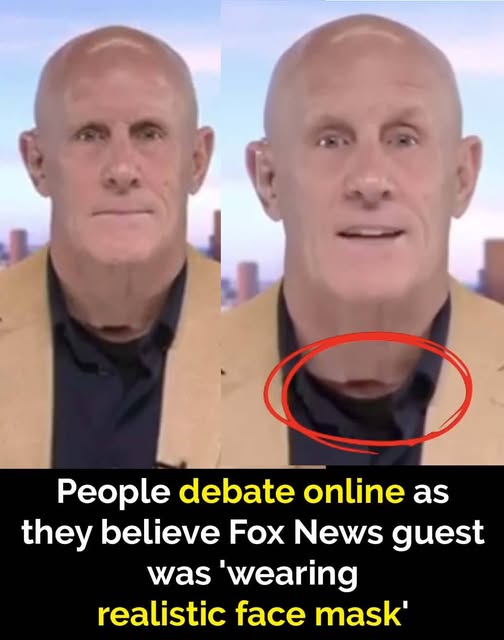
A brief moment during a recent Fox News broadcast unexpectedly exploded into a viral online conspiracy after viewers focused intensely on the appearance of Robert Harward during a television segment.
What began as an ordinary interview quickly transformed into internet speculation when social media users isolated a single frame from the broadcast and began claiming they noticed what appeared to be an unusual line or crease near Harward’s neck.
Almost immediately, screenshots spread across platforms including Reddit, X, TikTok, and conspiracy-focused forums. Users zoomed into the image repeatedly, slowing clips frame-by-frame and posting annotations suggesting the visual detail looked like the edge of a “human mask.”
For some online communities already inclined toward distrust and hidden-theory narratives, the image became instant “evidence” of something deceptive taking place onscreen.
The speculation escalated rapidly.
Posts began claiming the man appearing on television was an imposter or digitally altered figure. Others expanded the theory further, connecting the clip to broader online conspiracies involving disguises, deepfakes, secret doubles, and staged media appearances.


6
But while the theories spread quickly, many viewers and experts pushed back almost immediately.
Video production specialists, lighting professionals, and media analysts explained that visual distortions like this are extremely common in broadcast television — especially when footage is paused, enlarged, compressed, or viewed at low resolution.
Studio lighting itself can dramatically alter how skin, fabric, and shadows appear on camera.
Harsh overhead lights often create deep contrast around the neck, jawline, collar, and clothing folds. Combined with compression artifacts from streaming platforms and screenshot degradation, perfectly ordinary details can suddenly appear strange when isolated from motion and context.
Experts noted that when viewers freeze single frames from moving video, the human brain naturally begins searching for patterns or inconsistencies. This tendency becomes even stronger when social media discussions frame an image as suspicious before people view it themselves.
Psychologists sometimes refer to this phenomenon as pattern perception — the brain’s tendency to assign meaning or hidden structure to ambiguous visual information.
Pareidolia
Once enough people publicly claim they “see something,” others often begin interpreting the image through the same lens, even when no actual evidence supports the conclusion.
In this case, layered clothing, neck shadows, camera compression, skin folds, and lighting reflections likely combined to create the illusion that viewers interpreted incorrectly after repeated zooming and frame analysis.
Importantly, no credible evidence has emerged supporting the claim that Harward was wearing a mask, disguised, digitally manipulated, or replaced by an imposter during the broadcast.
No verified experts in visual effects, television production, or forensic media analysis have supported the conspiracy claims.
Still, the incident spread widely because it reflects something larger about modern internet culture.
Today, a single unusual frame from a video can become global discussion within hours. Social media platforms reward emotional reaction, mystery, and controversy far more aggressively than calm explanation. As a result, harmless visual anomalies often evolve into elaborate theories long before factual analysis catches up.
This dynamic has become increasingly common in the digital era.
Low-resolution clips.
Paused frames.
Audio distortions.
Lighting glitches.
Compression artifacts.
All of them can quickly become “evidence” online once removed from original context.
Conspiracy-driven communities especially thrive on this kind of ambiguity because uncertainty allows speculation to grow endlessly. Once a theory gains momentum emotionally, ordinary explanations often feel less satisfying to people already invested in believing something hidden or extraordinary is happening.
That emotional momentum matters more than evidence in many viral conspiracies.
And perhaps that is the most revealing part of incidents like this.
Not the visual illusion itself — but how quickly large groups of people become convinced ordinary technical imperfections must conceal something deeper.
The Harward clip ultimately appears to be another example of how modern media environments amplify suspicion through repetition, selective framing, and emotional interpretation.
A shadow becomes a “mask.”
Compression becomes “proof.”
And an ordinary television segment transforms into national internet speculation within hours.
In the end, the situation serves as a reminder of how easily misinformation and conspiracy theories can spread online — especially when people analyze isolated moments without technical context or verified evidence.
Because sometimes the strangest thing on the internet is not the image itself.
It is how quickly millions of people can convince themselves they are seeing something that was never actually there.
 admin
admin