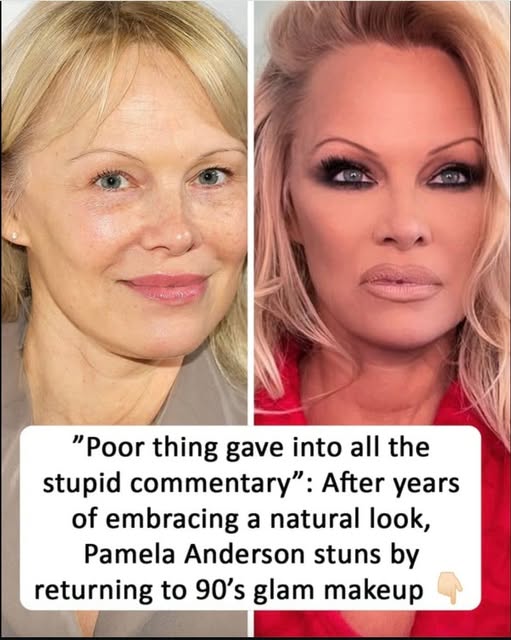
For years, Pamela Anderson shocked Hollywood not by wearing more makeup… but by wearing none at all.
While much of the entertainment industry doubled down on filters, cosmetic perfection, and carefully engineered beauty, Pamela quietly stepped away from the image that once defined an entire era. Bare-faced red carpet appearances, natural skin, minimal styling — she became unexpectedly symbolic of something deeper than glamour: freedom from performance.
That’s why the internet nearly froze when she suddenly appeared transformed once again.
One photo.
One dramatic swipe of eyeliner.
And suddenly the 90s were back.


4
Fans immediately recognized the visual language of the transformation. The heavy lashes. The smoky liner. The oversized blonde hair styled with unmistakable old-Hollywood bombshell energy. It wasn’t subtle nostalgia — it was a deliberate return to the image that made Pamela Anderson one of the most recognizable faces on earth during the 1990s.
And people online reacted instantly.
Some called it iconic.
Others said it felt like “watching a time machine open.”
Many admitted they had forgotten just how powerful her signature look once felt culturally until seeing it return all at once.
But what made the moment resonate so strongly wasn’t simply the makeup itself.
It was what the transformation represented.
Because Pamela Anderson’s relationship with beauty and public image has changed dramatically over the years. During the height of her fame through Baywatch and endless tabloid attention, her appearance became more than celebrity style — it became global pop culture mythology.
The platinum hair.
The dramatic makeup.
The hyper-glamorous bombshell image.
For years, that aesthetic followed her everywhere, often overshadowing deeper conversations about who she actually was beneath it.
Then came the shift nobody expected.
In recent years, Pamela began appearing publicly without makeup almost entirely. Red carpets, fashion events, interviews — she embraced natural aging in a way that felt unusually vulnerable inside an industry obsessed with perfection. Rather than hiding behind the image the world expected, she seemed to intentionally strip it away.
That decision earned enormous admiration from many women who viewed her evolution as quietly radical.
Instead of chasing eternal reinvention through cosmetic illusion, Pamela appeared to be reclaiming ownership over her face, identity, and visibility.
Which is precisely why this sudden return to full glamour created such fascination online.
Because it didn’t feel like regression.
It felt like choice.
That distinction matters.
The internet initially reacted with shock because people assumed Pamela had “abandoned” that version of herself forever. But the new appearance suggested something more emotionally interesting: she had not rejected glamour — she had simply stopped needing it constantly.
Now, wearing it again felt playful instead of obligatory.
Confident instead of performative.
Like a woman revisiting an old version of herself without being trapped inside it anymore.
Fans especially noticed the difference in energy. In the 90s, the bombshell image often felt packaged for public consumption. This time, many people described her appearance as self-aware, relaxed, and fully in control of the nostalgia surrounding her.
“She looks like she’s having fun with it now,” one fan commented online.
Others pointed out how unusual it feels to watch a celebrity reclaim an image that once consumed them emotionally. Rather than running from her past or desperately recreating it, Pamela appeared to be playing with it on her own terms.
And perhaps that is why the moment hit such a cultural nerve.
Because Pamela Anderson represents more than beauty nostalgia alone.
She represents reinvention.
For decades, the public projected fantasies, assumptions, and stereotypes onto her image. She was treated as symbol, fantasy, scandal, icon, punchline, and obsession often all at once. Yet over time, she quietly reshaped her narrative in ways few expected.
Through documentaries, interviews, activism, writing, and her stripped-down public image, people began seeing dimensions of her that fame once buried beneath eyeliner and headlines.
Now, seeing her suddenly return to full bombshell mode feels different emotionally because audiences no longer view her as trapped inside that identity.
Instead, it feels like she owns it.
Completely.
The internet loves transformations because they trigger nostalgia, surprise, and emotional memory simultaneously. But this moment carried something more layered underneath the surface glamour.
It wasn’t just:
“Pamela Anderson looks like the 90s again.”
It was:
“Pamela Anderson can become any version of herself she chooses.”
Natural.
Glamorous.
Bare-faced.
Bombshell.
Elegant.
Unfiltered.
All of them remain authentically hers.
And maybe that is the most powerful part of the reaction surrounding the photo.
Not simply the makeup.
But the realization that after years of being defined by appearance, Pamela Anderson now seems completely free to play with her image without being controlled by it anymore.
Which somehow makes her look even more iconic now than she did the first time around.
 admin
admin