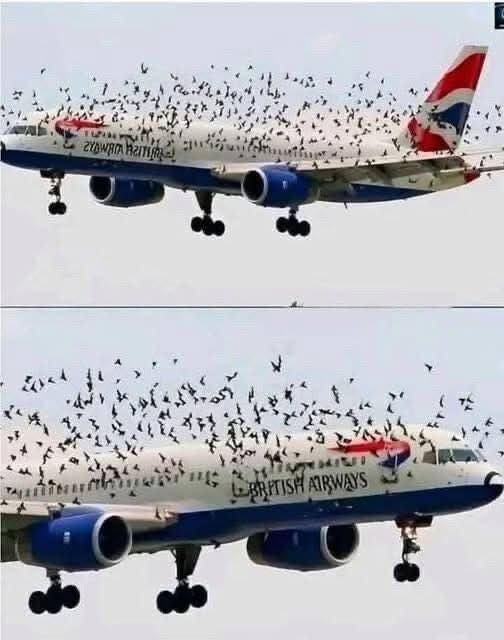
The flight was supposed to be forgettable.
For Captain Jason Vance, it began like hundreds of others before it — routine altitude checks, calm weather patterns, predictable radio communication, and the steady mechanical rhythm pilots eventually stop consciously noticing after years in the sky. Nothing about the departure suggested the journey would become the kind of story people survive rather than simply complete.
At first, the birds barely registered as a threat.
A few shapes moved near the wings, catching sunlight briefly as they crossed the aircraft’s path. Bird activity around flight routes is not unusual. Pilots are trained to remain alert but calm, knowing most encounters pass harmlessly within seconds.
But this felt different almost immediately.
The scattered movement outside the cockpit thickened unnaturally fast. What had been a few birds became dozens. Then hundreds.
Within moments, the sky itself seemed to shift.
The flock descended around the aircraft in violent waves, surrounding the plane so densely that visibility blurred beneath feathers, shadows, and frantic movement. The sound began first — sharp impacts against the fuselage like fists striking metal at impossible speed.
Then came the panic.
Passengers screamed as bodies of birds slammed repeatedly into the aircraft. Feathers exploded across the windshield. Warning systems activated simultaneously inside the cockpit while Captain Vance struggled to maintain stability against turbulence and engine stress.
The flock did not behave randomly.
That was the part he could not understand.
Birds usually scatter from aircraft noise and speed. These birds surged toward it.
Again.
And again.
As though something inside the plane mattered more to them than survival itself.
Then disaster escalated.
A large bird disappeared directly into one of the engines.
The explosion shook the aircraft violently, followed by the horrifying sound every pilot fears most: catastrophic engine failure. The plane lurched sideways as alarms erupted throughout the cockpit. Smoke and the sharp smell of burning systems filled the cabin while passengers descended into chaos behind him.
In seconds, the flight transformed from emergency… into potential catastrophe.
Vance realized immediately he would never reach the safety of the main airport.
The damaged aircraft was losing stability too quickly.
Searching desperately below, he spotted what looked like an abandoned landing strip near a remote lake — cracked pavement half-consumed by weeds and isolation. It wasn’t safe. It barely looked usable.
But it was the only option left.
Fighting the controls with shaking hands, he angled the failing aircraft downward, relying on the remaining engine to keep the nose steady long enough to survive impact. The landing came brutally. Tires slammed dirt and broken asphalt. Metal screamed beneath the plane as it skidded violently across the neglected strip before finally grinding to a halt in stunned silence.
For a moment, nobody moved.
People simply breathed.
Alive.
But the silence outside did not last.
The birds remained.
That was what unsettled Jason most after the crash. Instead of dispersing once the aircraft stopped, the flock continued circling overhead in massive numbers. Their cries echoed across the isolated lake while shadows moved endlessly above the wreckage.
Not random movement.
Not panic.
Waiting.
Passengers remained terrified inside while emergency communication systems struggled to reconnect remotely. Jason stepped cautiously from the aircraft expecting the birds to scatter from human presence.
They didn’t.
Instead, dozens hovered nearby, focused intensely on one area of the plane:
The cargo hold.
That was the moment something cold settled into his stomach.
Instinctively, he knew the birds were not attacking the plane itself.
They were following something inside it.
Armed with only a flashlight and growing dread, Jason forced open the damaged cargo bay doors. Industrial crates filled most of the compartment exactly as listed in the flight manifest.
Then he noticed the hidden section behind them.
A concealed compartment.
Unregistered.
Locked separately.
Inside, stacked carefully in insulated containers, were dozens of exotic bird eggs — fragile, rare, stolen.
The realization hit with devastating force.
The flock had never been acting irrationally.
They had been fighting.
Protecting.
Trying desperately to reclaim what had been taken from them.
Those impacts against the aircraft suddenly transformed emotionally in his mind. What felt like violent attack now revealed itself as something far older and more primal: parental instinct so powerful it drove wild creatures to challenge a roaring machine of steel and fire.
The birds had followed the plane because their offspring were inside it.
Stolen from nests.
Trafficked for profit.
Reduced to cargo.
Jason stared at the eggs while the cries outside echoed across the wreckage. For the first time since the nightmare began, fear gave way to something heavier:
Shame.
Because unknowingly, he had transported a crime against nature itself.
The birds circling above no longer sounded threatening to him.
They sounded grieving.
Desperate.
Their relentless pursuit suddenly felt heartbreaking rather than monstrous. They had crossed impossible distances, risked death against engines and metal, and refused to abandon the stolen lives hidden inside the plane.
And perhaps that was what shattered him emotionally in the end.
Not the crash.
Not the near-death experience.
But the realization that the most terrifying force he encountered in the sky was not violence…
It was devotion.
The instinct to protect one’s young at any cost.
Sitting inside the damaged cargo hold surrounded by stolen eggs, Captain Vance finally understood what the flock had been trying to say all along.
The birds were not monsters.
They were parents.
And sometimes love — even in its wildest, most desperate form — becomes powerful enough to chase steel across the sky itself.
 admin
admin