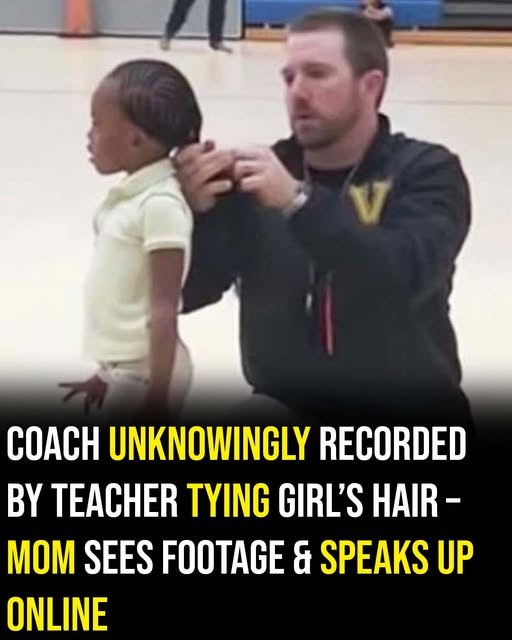
In a busy, echoing elementary school gym in Valdosta, Georgia, a small and seemingly ordinary moment quietly unfolded—one that would later travel far beyond the school walls and resonate with audiences across the country. It happened during a kindergarten basketball activity, where young children were learning the basics of movement, coordination, teamwork, and fun in a setting filled with energy, noise, and constant motion. Among them was a physical education teacher and coach, Jonathan Oliver, who was doing what he always did: guiding, encouraging, and keeping an eye on his students as they participated in the game.
The environment was typical of early childhood sports activities. Small sneakers squeaked across the polished gym floor, children called out to one another with excitement, and the rhythm of bouncing basketballs filled the air in an unstructured but joyful chorus. In the middle of it all stood Oliver, attentive and focused, making sure each child was included, supported, and safe while they explored the game. For him, it was just another day of teaching physical education—balancing structure with the natural unpredictability that comes with teaching very young children.
During a brief pause in activity, a kindergarten student named Kristen approached him. She was small, like most of her classmates, and carried the simple urgency that young children often have when something is bothering them. She had a personal request that, in her eyes, felt important enough to interrupt the flow of the game. Her hair, she explained, was getting in her way. It was distracting her and making it harder for her to see clearly while she tried to participate in the game. She asked, in a straightforward and innocent way, whether he could help her put her hair into a ponytail so she could play more comfortably.
It was a simple request, one that might seem minor to an adult observer but felt meaningful in the moment to a child trying to focus on an activity. Without any hesitation, and without treating the request as unusual or inconvenient, Jonathan Oliver stepped away from what he was supervising. He knelt down so he could be at her level, creating a moment of calm within the lively gym environment. With gentle attention, he gathered her hair and tied it into a ponytail, ensuring she would be able to continue playing without distraction.
There was no dramatization in the act, no pause for attention, and no sense that it was anything extraordinary to him. It was simply a teacher responding to a student’s need in real time. He treated it as part of his responsibility, not something separate from his role. To him, ensuring that a child could participate comfortably and confidently was just another extension of teaching and supervision.
What made this moment later stand out was not its complexity, but its simplicity. A fellow staff member happened to record the interaction on video, not anticipating that it would ever reach beyond the school setting. At the time, it appeared to be one of those fleeting, everyday occurrences that happen in schools all the time and are quickly forgotten. There was no expectation that it would be shared widely or become the focus of public attention.
However, once the footage began circulating online, it quickly drew the interest of viewers. People were struck by the quiet kindness displayed in the interaction. The image of a teacher calmly kneeling down to help a young student with something as simple as tying her hair became symbolic in ways that extended beyond the immediate situation. It reflected an attitude of care that many associated with educators but rarely see captured so clearly.
As the video continued to spread across social platforms, it gained momentum. Viewers from different backgrounds responded to it in similar ways, often expressing appreciation for the gentleness of the gesture. In a world where online content is frequently filled with controversy or negativity, this short clip stood out because it showed something universally understandable: a moment of patient, human kindness between an adult and a child in a learning environment.
Eventually, the story reached national media outlets, where it was featured and discussed more broadly. In these discussions, the focus was not only on the act itself but on what it represented. For many parents and educators watching, it highlighted the often unseen emotional and practical labor that teachers perform every day. Beyond lesson plans and structured instruction, teachers frequently find themselves responding to personal needs, small crises, and moments that require compassion rather than curriculum.
Kristen’s mother also responded to the attention the video received. For her, the moment was not surprising. She already understood the character of the teacher and the environment in which her child was being cared for. Her reaction reflected a sense of trust and reassurance rather than shock. She viewed the gesture as consistent with the kind of support and attentiveness she had come to expect from those responsible for her daughter’s daily care at school.
This perspective added another layer to the public response. While many viewers saw the video as an extraordinary example of kindness, those closer to the situation saw it as a reflection of everyday reality in classrooms where teachers regularly go beyond formal responsibilities to meet the needs of their students. The difference in perception highlighted how much unseen effort is often involved in education, particularly in early childhood settings where children are still developing independence and self-management skills.
The moment involving Oliver and Kristen began to take on a symbolic meaning. It was no longer just about a ponytail or a brief interaction in a gym. Instead, it came to represent the broader role of educators in shaping not only academic understanding but also emotional security and confidence in young learners. Teachers often become figures of stability and trust for children who are still learning how to navigate structured environments away from home.
In many ways, the gesture demonstrated how education extends far beyond textbooks, tests, or formal instruction. It includes moments of reassurance, physical assistance, emotional encouragement, and attention to small details that can significantly affect a child’s comfort and participation. Something as simple as adjusting a hairstyle became, in this context, an example of removing a barrier so a child could fully engage in learning and play.
As the story circulated further, many viewers reflected on their own experiences in school. Some remembered teachers who had helped them in similarly small but meaningful ways—tying shoes, offering encouragement before a presentation, or stepping in during moments of uncertainty. Others, particularly parents, expressed appreciation for educators who act with patience and empathy in situations that might otherwise be overlooked.
The widespread reaction underscored how powerful simple acts of kindness can be when they are seen through a wider lens. While large accomplishments and dramatic events often dominate public attention, it is often the quiet, uncelebrated moments that leave the most lasting emotional impressions. The video of Oliver helping Kristen became an example of how everyday compassion can resonate deeply when it is recognized and shared.
For many educators, the story also served as a reminder of the multifaceted nature of their profession. Teaching young children often involves shifting constantly between roles—educator, caretaker, mediator, and sometimes even comforter. Each day brings unpredictable needs that require flexibility, patience, and a willingness to respond in the moment. Acts like adjusting a student’s hair are not separate from teaching; they are part of creating an environment where children feel comfortable enough to learn and participate fully.
As discussions continued, the broader importance of empathy in education became a central theme. The ability to recognize and respond to a child’s immediate needs, even when they seem small, contributes to building trust between students and teachers. That trust, in turn, supports learning and development in ways that structured instruction alone cannot achieve. Children who feel seen and cared for are often more confident and engaged in their activities.
The story also illustrated how modern media can amplify moments that might otherwise remain local and unseen. A brief classroom interaction, recorded without expectation, transformed into a widely shared example of kindness. This transformation speaks to the way digital platforms can elevate everyday human experiences, allowing them to reach audiences far beyond their original context.
Yet despite the attention it received, the essence of the moment remained unchanged. It was still a teacher responding to a student’s need with patience and care. The simplicity of that action is what gave it its strength. There was no performance, no intention of recognition, and no awareness that it would later be viewed by thousands or even millions of people.
In reflecting on the story, many were reminded that the most meaningful acts of care are often the ones that happen quietly, without acknowledgment. In classrooms, hallways, playgrounds, and gymnasiums across the world, similar moments occur every day. They may not be recorded or shared, but they contribute significantly to shaping children’s experiences and memories of school.
Ultimately, the interaction between Jonathan Oliver and Kristen serves as a reminder of the human side of education. It highlights how learning environments are built not only on instruction and curriculum but also on kindness, patience, and attention to individual needs. A simple ponytail, tied in the middle of a noisy gym, became a powerful symbol of the quiet dedication many educators demonstrate daily.
In the end, what lingered most in the minds of those who saw the video was not the activity itself, but the feeling it conveyed. It spoke to care without conditions, attention without expectation, and kindness expressed in its most natural form. And sometimes, those small, unassuming moments are the ones that leave the deepest and most lasting impressions of all.
 admin
admin