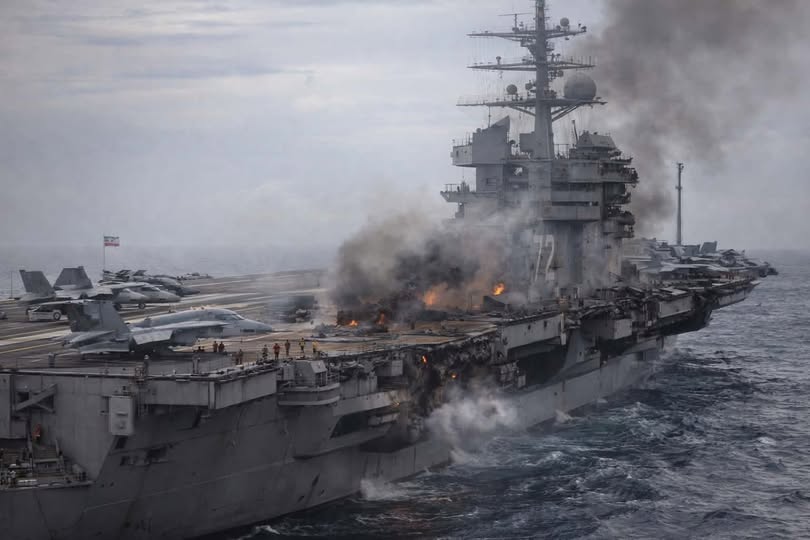
The waters of the Arabian Sea have become the center of a tense and uncertain moment, shaped as much by competing narratives as by actual events on the ground
Reports from Tehran described a strike on the USS Abraham Lincoln (CVN-72), framing it as a calculated response to recent military actions. Almost immediately, officials from United States Central Command rejected those claims, stating the carrier remains fully operational and unaffected. Each side has spoken with confidence. Yet confidence alone does not resolve truth.
What is clear is this: the situation carries weight, regardless of which version is accurate.
A Conflict Shaped by Narrative
In moments like these, information moves quickly—but clarity does not.
Statements from the Islamic Revolutionary Guard Corps presented the reported strike as both retaliation and demonstration. On the other side, the United States emphasized continuity—routine operations, no disruption, no damage.
Between those positions lies uncertainty.
Not all claims are equal, but neither should they be dismissed without careful attention. In times of tension, words can escalate just as much as actions. Sometimes more.
What Is at Stake
The USS Abraham Lincoln (CVN-72) is not just a military asset—it represents presence, deterrence, and the weight of commitment in a volatile region. Any confirmed attack would carry serious consequences, not only militarily but politically.
Yet escalation is not inevitable.
There is still space—however narrow—for restraint, for verification, for measured response rather than immediate reaction.
That space is fragile, and it depends on decisions made quietly, often away from public view.
The Wider Impact
Even unconfirmed events can ripple outward.
Markets react to uncertainty before facts settle. The possibility of disruption near the Strait of Hormuz has already stirred concern, reminding how closely global stability is tied to this region.
Governments are watching carefully. Not only for what has happened, but for what might follow if misjudgment replaces patience.
Holding Perspective
It is easy, in moments like this, to be drawn toward the most dramatic interpretation.
But tension does not always lead to confrontation.
Sometimes it reveals how close the edge is—and how necessary it is to step back from it.
For now, the carrier continues its patrol, and the situation remains unresolved. The truth will emerge more clearly with time, but the responsibility to avoid unnecessary escalation exists now.
Final Thought
Strength is often measured in response, not reaction.
In a climate where every statement can shift the balance, restraint becomes its own form of power. The coming days will not only test military readiness, but also the willingness of all sides to hold steady when it matters most.
 admin
admin