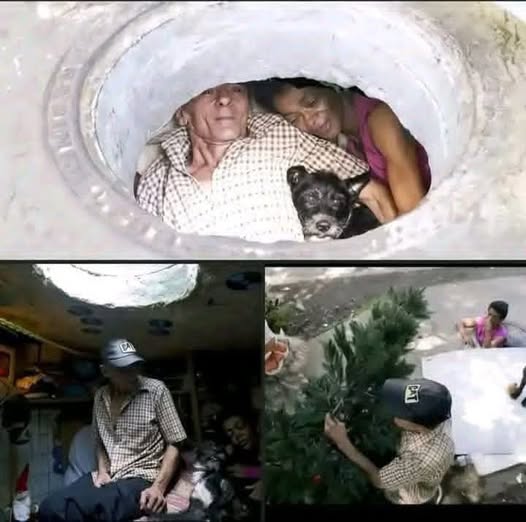
From the outside, it looks like nothing more than a massive piece of discarded construction material — a hollow concrete drainage pipe resting quietly on bare ground. Something designed to carry stormwater. Something meant to be buried.
But inside, it tells a very different story.
For one couple and their loyal dog, that curved stretch of concrete has become home — not by choice, but by necessity.
In a world where safe and stable housing remains out of reach for far too many, survival often means adapting to spaces never intended for living. The pipe’s circular interior has been transformed with careful effort. A mattress rests against the curved wall. Blankets are folded neatly. A few personal belongings are arranged with intention, not chaos. Small touches — the placement of items, the organization of space — reflect a quiet determination to preserve dignity.
The structure offers limited protection. It shields them from wind and rain better than open ground would. The thick concrete walls dampen some of the outside noise. But it is not insulated. It is not secure. It is not designed for human life.
And yet, for now, it is shelter.
The presence of their dog adds a layer of tenderness to an otherwise stark scene. In times of instability, animals often become anchors. They provide companionship when isolation threatens to overwhelm. They offer routine — feeding times, walks, moments of affection — that create a sense of normalcy in abnormal conditions.
For many experiencing housing insecurity, pets are not optional. They are family. They are emotional support systems in a world that can feel indifferent.
Living inside a drainage pipe comes with constant challenges. Privacy is nearly nonexistent. Access to clean water, sanitation, and electricity is uncertain. Extreme temperatures can transform the concrete into an oven in summer or a freezing chamber in winter. Heavy rain raises the terrifying possibility of flooding.
Each day requires vigilance.
Yet despite these hardships, there is visible effort. Effort to keep the space orderly. Effort to care for their dog. Effort to maintain a shared life within narrow walls.
That effort speaks to something important: resilience.
Housing insecurity is often reduced to numbers and statistics — rising rents, limited affordable units, gaps in support systems. But behind every statistic is a human story. A relationship. A set of hopes that didn’t disappear simply because stability did.
Scenes like this challenge us to look deeper. The concrete pipe is not just an improvised shelter. It represents the widening gap between housing costs and wages. It reflects the reality that even hardworking individuals can find themselves without safe options. It underscores how quickly circumstances — job loss, medical bills, unexpected crises — can destabilize lives.
At the same time, it reminds us that home is more than walls and a roof. It is safety. It is privacy. It is the ability to rest without fear of displacement. It is the foundation for opportunity — employment, health, education, community connection.
When those elements are missing, people adapt in ways that are both heartbreaking and remarkable.
The couple’s effort to create comfort within concrete speaks not of failure, but of endurance. Of refusing to surrender entirely to circumstance. Of holding onto companionship and routine even when stability feels distant.
Addressing homelessness requires more than temporary fixes. It requires empathy. Coordinated community action. Long-term investment in affordable housing, accessible services, and support systems that prevent people from slipping through the cracks in the first place.
Because no one dreams of living inside a drainage pipe.
But until sustainable solutions become reality, improvised shelters will continue to appear in overlooked spaces — quiet reminders that dignity persists, even when security does not.
And sometimes, resilience is found in the most unexpected places.
 admin
admin