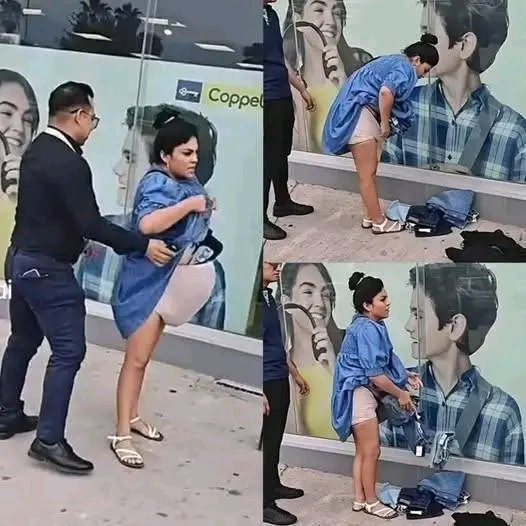
The first thing anyone notices is the glass.
It runs behind her in a long, flawless plane, clean enough to reflect faces, expressions, and a version of reality that feels staged—two smiling models locked in a perfect moment of commercial intimacy. Their laughter is frozen, curated, untouched by weather or consequence. The glass separates inside from outside, comfort from exposure, fantasy from whatever this moment is becoming.
In front of it stands a woman who is very much not frozen.
She is caught mid-motion, one leg bent, fabric slipping, skin visible where skin is apparently not supposed to be. Her body is angled awkwardly, as if she has been interrupted halfway through becoming something else—more comfortable, more herself, or maybe just less scrutinized. The denim shirt she wears is oversized, borrowed or chosen for ease, and now it hangs unevenly, pulled in a direction she did not intend.
A man stands behind her, hand outstretched, not quite touching but close enough to claim authority. His posture is firm, professional, trained. He is not violent, not frantic, not emotional. That might be the strangest part. He looks like someone doing a job, enforcing a rule that exists whether or not it makes sense in this exact moment.
Rules are invisible until they’re not.
The sidewalk beneath them is ordinary concrete, scuffed and indifferent. People have passed here thousands of times without incident, without pause, without becoming a story. But today, time slows. Today, a woman lifting a leg becomes an event. Today, fabric becomes evidence.
Her face—if you look closely—doesn’t show embarrassment so much as irritation mixed with resolve. There’s tension there, but also something stubborn. She is not shrinking. She is not apologizing with her body. She looks like someone who has decided she will finish what she started, even if the world has decided to watch.
And the world is watching.
Not just the man behind her, not just the unseen bystanders outside the frame, but the people who will see this image later, divorced from context. People who will zoom, judge, narrate. People who will decide what kind of woman she is based on a single interrupted movement.
Public space has rules, but they are unevenly applied. Men change shirts in parking lots and sidewalks and beaches without a second glance. A torso is just a torso—unless it belongs to someone whose body has been politicized by default. Unless it belongs to someone who has learned, early on, that visibility is never neutral.
What does it mean to exist in public when your body is always being interpreted?
The photo doesn’t answer that question. It just asks it loudly.
Behind the glass, the advertisement smiles. The models are dressed perfectly, styled down to the millimeter. Their closeness is intimate but safe, their bodies approved by marketing departments and corporate policies. They represent desire without consequence, beauty without agency. No one will stop them. No one will question whether their clothing—or lack of it—belongs there.
The contrast is almost cruel.
In front of the glass, reality intrudes. The woman’s bag lies on the ground, open, spilling items that were meant to remain private. A shoe waits beside it, patient and absurd. These small details ground the scene, reminding us that this isn’t a performance. This is logistics. This is a person trying to manage her day.
Something didn’t go as planned.
Maybe she was changing out of work clothes. Maybe something tore. Maybe she just wanted comfort. The photo doesn’t say, and that silence is important. The lack of explanation forces the viewer to confront their own assumptions. Are you filling in the blanks with empathy, or with judgment?
The man’s presence shifts the entire tone. Without him, this would be a moment of vulnerability, perhaps even defiance. With him, it becomes a confrontation between individual need and institutional order. His uniform—subtle but unmistakable—signals authority. Not moral authority, but procedural authority. The kind that doesn’t care why, only whether.
Rules don’t ask how you’re feeling.
She lifts her leg higher, continuing despite interruption. That choice matters. It transforms the moment from passive exposure into active insistence. She is saying, without words, I am not done. She is claiming control over her own body in a space that is attempting to regulate it.
There’s courage in that, even if it doesn’t look cinematic.
This is not a heroic stance, not a dramatic pose. It’s messy. It’s awkward. It’s human. And that’s precisely why it resonates. Most acts of resistance don’t look like speeches or marches. They look like finishing what you started while someone tells you that you shouldn’t.
The photo exists now as a fragment, circulating without her consent. That, too, is part of the story. Her image becomes content, her discomfort entertainment, her body a topic of debate. People will argue about propriety, about legality, about decency. Few will ask what it feels like to be interrupted mid-necessity by a system that treats your body as a potential problem.
There’s a particular loneliness in that.
The glass reflects but does not acknowledge. The models’ smiles are immune. They do not look at her. They look at each other, locked in a loop of idealized connection. Their presence amplifies the absurdity of the situation. Sexuality is permitted when it sells, forbidden when it belongs to someone outside the script.
Who decides the script?
The woman’s posture suggests she knows this isn’t really about clothing. It’s about control. It’s about who gets to be comfortable and who must always be cautious. It’s about how quickly a woman’s body becomes public property the moment it deviates from expectation.
She is not screaming. She is not crying. She is simply continuing.
That might be the most radical thing in the frame.
The man behind her will probably remember this as an inconvenience. A moment of mild tension in an otherwise forgettable shift. He will tell the story without detail, if he tells it at all. For him, the rules worked as intended. Order was maintained.
For her, the moment lingers.
It lingers in the memory of being watched. In the aftertaste of adrenaline. In the calculation she may make next time: Is it worth it? Is it safer to be uncomfortable than to be seen?
These are the quiet negotiations women carry every day.
The photo captures none of the aftermath, but it implies it. The way her shoulders are set suggests she will walk away with her head up. The way her foot is still raised suggests she refuses to rush, refuses to be shamed into urgency.
There is dignity in that refusal.
Public space often pretends to be neutral, but it is coded with expectations. Behave, dress, move in ways that do not disrupt the visual order. Blend in. Don’t remind anyone that bodies exist outside of advertisements.
This woman disrupts simply by being unfinished.
And maybe that’s why the image feels uncomfortable. It exposes the gap between how bodies are sold and how bodies live. Between permission and necessity. Between glass-perfect fantasy and concrete-level reality.
The photo ends, but the questions don’t.
Who gets to decide what is acceptable in public?
Who benefits from those decisions?
And why does a moment of human practicality feel more transgressive than a wall-sized image of curated intimacy?
The woman lowers her leg eventually. The man steps back. The sidewalk returns to normal. But for a fraction of time, captured and shared, the illusion cracks.
Between glass and skin, reality insists on being seen.
 admin
admin