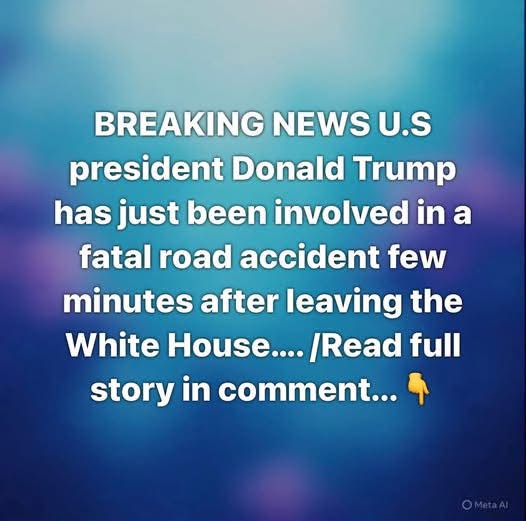
The claim that former U.S. President Donald Trump was involved in a fatal road accident is false. What is real—and deeply troubling—is a pattern of political violence that once again placed an American leader in mortal danger and forced the country to confront how fragile public life has become.
On September 15, 2024, Trump narrowly survived a second assassination attempt. The incident came just weeks after another violent episode at a campaign rally in Pennsylvania, where gunfire left him injured and sent shockwaves through the nation. Later that summer, while Trump was playing golf in Florida, his security detail engaged an armed suspect near the course, thwarting what authorities described as another credible threat to his life. Taken together, these events revived an uncomfortable truth: in the United States, occupying—or having occupied—the presidency carries real and persistent danger.
This reality is not new. Since the nation’s founding, forty-five men have served as president, and an astonishing number of them have faced assassination attempts. Nearly forty percent of U.S. presidents were targeted by would-be killers. Four did not survive. Abraham Lincoln, James A. Garfield, William McKinley, and John F. Kennedy were all assassinated while in office, their deaths marking some of the darkest chapters in American history.
For the others who survived, chance, quick thinking, or sheer luck made the difference between life and death. Each attempt reflected a volatile mix of political rage, personal grievance, mental instability, or a desperate desire for notoriety. Together, they reveal a long-standing vulnerability at the heart of American democracy: its leaders are both powerful symbols and dangerously accessible targets.
Presidents are never just individuals. They become embodiments of national identity, policy, and direction. Admiration can quickly curdle into obsession or hatred. For some attackers, violence becomes a warped form of communication—a way to feel seen, heard, or remembered. Trump’s recent experiences fit squarely within this grim tradition, but with a modern twist. In at least two cases, the individuals accused of targeting him were reportedly former supporters who had turned against him, illustrating how political disillusionment can mutate into something far more dangerous.
History offers sobering parallels. The assassination of Abraham Lincoln in 1865 was not an isolated act but part of a coordinated conspiracy meant to destabilize the federal government at the close of the Civil War. That same night, Secretary of State William Seward was stabbed in his home and narrowly survived, while the plot to kill Vice President Andrew Johnson failed only because the assigned attacker lost his nerve. The intent was clear: remove the nation’s leadership and throw the country into chaos. Though the plan collapsed, it exposed how vulnerable the system could be.
Other presidents escaped death by the thinnest of margins. Gerald Ford survived two assassination attempts in 1975—an unusual year in presidential security history. The first attacker, Lynette “Squeaky” Fromme, a follower of Charles Manson, aimed a gun at Ford during a public appearance in Sacramento. The weapon failed to fire. Seventeen days later, Sara Jane Moore fired shots at Ford in San Francisco, only to have her aim deflected by a bystander, Oliver Sipple, whose split-second action saved the president’s life.
In 1981, Ronald Reagan was shot outside a Washington hotel by John Hinckley Jr. A ricocheting bullet pierced Reagan’s lung, and the nation watched anxiously as he was rushed into surgery. Reagan survived, and his calm humor during recovery—most famously joking to surgeons that he hoped they were Republicans—became part of his public legend. The moment reassured a shaken country, but it also underscored how close the United States had come to another catastrophic loss.
Trump’s brushes with death reflect how the threat has evolved in the digital age. Political polarization is amplified by social media, misinformation spreads rapidly, and individuals can radicalize in isolation. While security measures have grown more sophisticated, so too have the pathways to violence. The fact that a former president, protected by the Secret Service and surrounded by security protocols, could still face repeated attempts in such a short span of time speaks to the scale of the challenge.
Assassination attempts are not merely personal tragedies or security failures. They are assaults on democratic stability itself. Each act of violence tests the resilience of institutions and forces the nation to confront how easily anger and extremism can spill into bloodshed. They also expose the delicate balance between open political expression and the need to protect those who serve in public life.
And yet, history also tells a story of endurance. Despite assassinations, attempts, and near misses, the American system has persisted. Power has transferred peacefully after tragedy. Courts have held. Elections have continued. In the aftermath of violence, moments of unity—however brief—have often followed, reminding citizens of shared values that transcend political divisions.
Trump’s survival in 2024 adds another chapter to this long and unsettling narrative. It reinforces the reality that leadership in America has always carried risk, and that no amount of power or prominence offers absolute protection. But it also highlights the strength of the institutions tasked with defending democratic order and the capacity of the nation to absorb shock without collapsing.
The history of assassination attempts against American presidents is a record of vulnerability intertwined with resilience. It reminds us that those who step into the presidency accept not only the burden of governance but the personal danger of becoming a symbol in a divided world. While individuals may be targeted, the endurance of the republic has so far outlasted every act of violence aimed at its leaders—a testament to a system that, though often tested, continues to stand.
 admin
admin