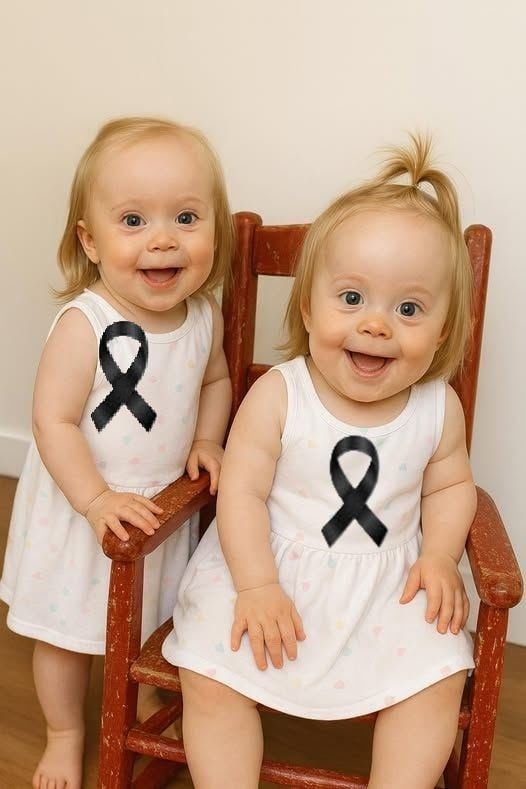
By the time firefighters arrived, the worst had been narrowly avoided.
The girls were pulled from the car shaken but unharmed, their small bodies wrapped in thick emergency blankets as neighbors stood in stunned silence, replaying every second in their minds. Smoke still drifted faintly through the air. Sirens faded into the distance. And the quiet that followed felt heavier than the chaos that came before it.
The father stood nearby, his face pale, his hands trembling. He did not resist as officers led him away. Witnesses said he looked broken—less like a criminal and more like someone who had reached the edge of something dark and unfamiliar, then realized too late how close he had come to losing everything.
Paramedics checked the children carefully, speaking softly, kneeling to meet them at eye level. One girl clutched a stuffed toy a neighbor had rushed to bring from her home. The other kept asking for her mother.
Behind the yellow crime-scene tape, neighbors whispered the same question over and over:
How does a moment like this begin?
No one could point to a single argument, a single bad decision, or a single hour that explained what had happened. To many, the father had seemed quiet, reserved, exhausted—but not dangerous. He worked long hours. He waved politely. He carried groceries for elderly neighbors.
And yet, something unseen had been growing.
In the days that followed, the street remained quieter than usual. Children stayed indoors. Adults spoke in lower voices. Flowers appeared on the sidewalk near where the car had been parked, placed by people who didn’t know what else to do with their fear and relief.
Anger came first.
Some residents demanded the harshest punishment possible. They spoke about accountability, about how nothing could justify endangering children. Their voices shook with outrage, fueled by the terrifying “what if” that still lingered in everyone’s thoughts.
But then something else surfaced.
Compassion.
Not forgiveness. Not excuses.
But the uncomfortable realization that crises do not always announce themselves loudly. That suffering can live behind closed doors, behind polite conversations, behind normal routines.
Mental-health professionals were brought in to support the children and their mother. Counselors visited the local school to help classmates understand what had happened without spreading fear. Social workers began the slow, careful process of untangling what the family had been living with long before that night.
Local leaders spoke publicly, urging residents to learn from what nearly became a tragedy.
“People wait too long,” one official said. “They think asking for help means failing. But silence is far more dangerous.”
Hotline numbers were shared. Community meetings were scheduled. Churches and support groups opened their doors.
The girls, according to authorities, are physically safe. They are staying with relatives for now, surrounded by people who are trying to restore a sense of normal life—meals at regular times, bedtime stories, quiet routines that say: you are safe.
Their father remains in custody, facing serious charges and undergoing psychological evaluation. Officials say his case will move slowly, carefully, with attention not only to the law but to the mental state that led to that moment.
Nothing about what happened will be simple to resolve.
There will be court dates. Therapy sessions. Long conversations no child should have to hear. Memories that will surface at night for years.
But there is also something else.
A fragile second chance.
For two children who will grow up knowing how close danger came—and how strangers ran toward them, not away.
For a community forced to confront the reality that pain does not always look violent until it is.
And perhaps even for a man who, at the darkest point of his life, did not fully cross the line that would have made forgiveness impossible.
What might have ended in funerals ended instead in ambulance lights fading into distance, in blankets wrapped around small shoulders, in neighbors holding their breath as life continued.
It is not a happy story.
But it is a reminder.
That desperation can hide in ordinary places.
That help must be offered before it is begged for.
And that sometimes, survival itself becomes a responsibility shared by everyone who witnessed the moment the fire did not win.
If you want, I can also rewrite this in:
 admin
admin