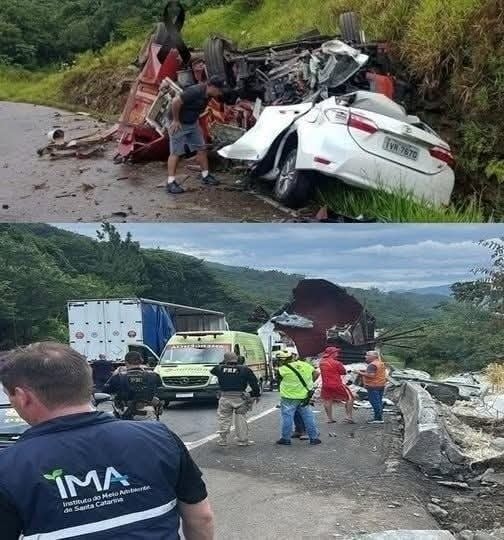
What should have been a quiet Tuesday night journey turned into one of the most heartbreaking road tragedies Brazil has seen in recent months.
On the night of the 13th, a violent head-on collision between a van and a truck transformed a stretch of BR-251 highway, near Grão Mogol in northern Minas Gerais, into a scene of devastation, silence, and unimaginable grief.
By the time emergency crews arrived, nine people had already d*ed, and twelve others were seriously injured.
The victims were workers traveling in a van, returning home to Ceará after completing their jobs. For many, the trip symbolized rest, family reunions, and the simple comfort of home. Instead, it became their final journey.
According to the first official findings released by the Civil Police of Minas Gerais (PCMG), the crash occurred after the truck crossed into the opposite lane, directly into the path of the oncoming van.
“It was a determining factor,” said forensic expert Hugo Leonardo.
Investigators carefully examined the scene for hours, studying:
- Tire marks
- Drag lines
- Deep grooves carved into the asphalt
These physical traces told a tragic story — one of sudden loss of control, no time to escape, and an impact so powerful that both vehicles were torn apart.
Rescue teams worked through the night under harsh lights, cutting through twisted metal to reach survivors trapped inside the wreckage. Firefighters, paramedics, highway police, and forensic specialists coordinated efforts in silence, broken only by radio calls and the sound of tools against crushed steel.
Ambulances transported the injured to hospitals across the region. Some were in critical condition, suffering broken bones, internal injuries, and severe trauma.
Meanwhile, families hundreds of kilometers away were still asleep… unaware that their loved ones would never arrive.
When morning came, phone calls changed lives forever.
Parents lost children.
Children lost fathers and mothers.
Partners lost their future.
Photos of the victims began circulating online, accompanied by messages of sorrow, anger, and disbelief.
“They were just trying to get home.”
“They worked hard.”
“This should never have happened.”
Residents of Grão Mogol say this section of BR-251 is notorious for dangerous driving, especially at night, when visibility is low and heavy vehicles dominate the road.
“This highway is a trap,” one local said. “We’ve warned about it for years.”
Traffic on the route was blocked for hours as investigators documented the scene and removed the wreckage. Long lines of vehicles formed in both directions, drivers stepping out of their cars in silence, many praying when they realized the scale of what had happened.
Authorities confirmed that a full technical report will be released in the coming days to determine whether speed, fatigue, mechanical failure, or road conditions contributed to the truck entering the wrong lane.
But for the families of the nine victims, no explanation can ease the pain.
This tragedy has reignited national debate about:
- Road safety on long-distance highways
- Stricter monitoring of truck drivers
- Nighttime driving conditions
- Fatigue among professional drivers
- And the urgent need for better infrastructure on BR-251
Across Brazil, people are asking the same painful question:
How many more lives must be lost before something changes?
For now, funerals are being prepared instead of homecomings.
Beds remain empty.
Messages remain unread.
Suitcases never unpacked.
A single mistake — a few seconds on a dark highway — destroyed dozens of futures.
What began as an ordinary trip ended in twisted metal, broken families, and a country in mourning.
And for those left behind, Tuesday night will forever mark the moment life split into before… and after.
 admin
admin