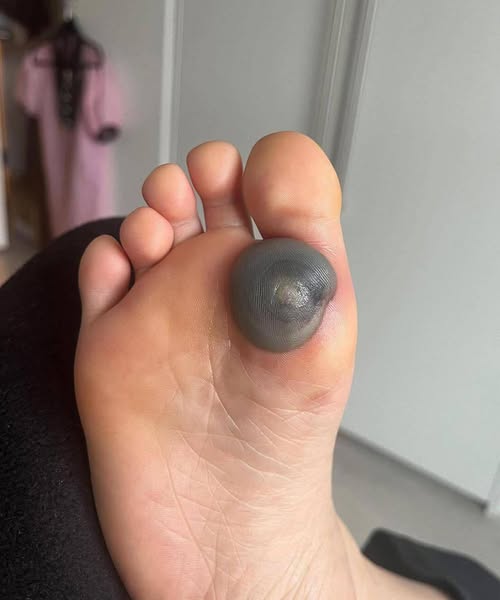
A dark, blood-filled blister suddenly appears on your skin.
It looks angry. Swollen. Almost bruised from the inside.
You tell yourself it’s “just a blister.”
But then a thought creeps in:
What if it isn’t?
What if it keeps coming back?
What if it shows up in your mouth… for no clear reason at all?
That tiny bubble might be your body’s quiet way of asking for attention.
What a blood blister really is
A blood blister forms when small, fragile blood vessels under the skin rupture but the surface of the skin remains intact. Instead of clear fluid, the blister fills with dark red or purple blood, creating that distinctive deep-colored bubble.
The most common causes are simple and familiar:
- Slamming a finger in a door
- Wearing tight or stiff shoes
- Repeated friction from tools or sports equipment
- Pinching or crushing injuries
- Accidental biting inside the mouth
- Dental procedures or sharp braces
In these cases, the blister is your body’s natural response to trauma. It seals the injured area, protects it from infection, and gives the tissue underneath time to heal.
Most blood blisters are harmless.
They usually fade on their own within one to two weeks, especially if you:
- Leave them unpopped
- Keep the area clean and dry
- Avoid pressure or friction
- Cover them lightly if needed
As uncomfortable as they look, they are often just part of the body’s repair system.
When a blood blister deserves more attention
The concern begins when the pattern changes.
A single blister after an injury is normal.
But frequent, unexplained, or recurring blood blisters are a different story.
They can sometimes be linked to underlying conditions, including:
- Diabetes
- Poor circulation
- Blood clotting disorders
- Vitamin deficiencies
- Autoimmune conditions
- Certain medications (such as blood thinners)
Blood blisters that appear repeatedly in the mouth, on the feet, or on areas that haven’t been injured should not be brushed aside.
Your skin is often the first place your body shows that something deeper may be off.
Warning signs you should never ignore
Most blood blisters heal quietly.
But you should seek medical advice if you notice:
- Severe or increasing pain
- Redness spreading around the blister
- Warmth in the surrounding skin
- Pus or cloudy fluid
- Fever or chills
- Numbness or tingling
- Very slow healing
- Blisters appearing without injury
- Blisters returning again and again
These signs can indicate infection, circulation problems, or systemic conditions that need proper evaluation.
Why popping it can make things worse
It’s tempting.
The blister looks tight. Dark. Ready to burst.
But popping a blood blister opens a direct door for bacteria.
This increases the risk of:
- Infection
- Scarring
- Delayed healing
- Deeper tissue damage
If it breaks accidentally, clean it gently with soap and water, apply antiseptic, and cover it loosely with a clean bandage.
Otherwise, letting it heal naturally is usually the safest choice.
The quiet message behind the blister
Most of the time, a blood blister is nothing more than a minor injury.
But sometimes…
It’s not just skin.
It’s circulation struggling.
It’s fragile blood vessels under stress.
It’s the body signaling imbalance.
It’s a warning whispered instead of shouted.
Modern life teaches us to ignore small discomforts. To “push through.” To wait until pain becomes unbearable.
But health rarely collapses in one dramatic moment.
It fades quietly first.
Through small signs.
Through patterns.
Through things easy to dismiss.
Like a dark bubble on your skin.
The bottom line
If you get a blood blister after an obvious injury and it heals normally, there is usually no reason to worry.
But if blood blisters:
- Appear often
- Have no clear cause
- Heal very slowly
- Or simply make you uneasy
Then seeing a healthcare professional is not overreacting.
It’s listening.
Your body speaks softly before it ever screams.
And sometimes, the smallest marks carry the most important messages.
 admin
admin