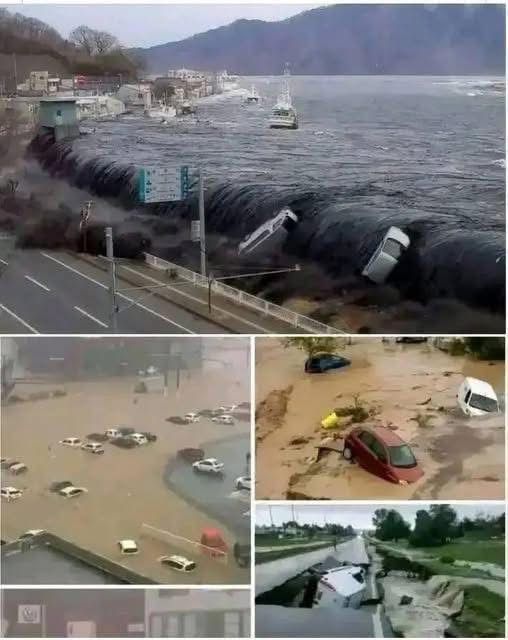
The sea did not roar.
It crept in.
By the time anyone understood what was happening, it was already too late.
There was no dramatic warning, no towering wall of sound at first—only a strange quiet that settled over Hirosato like a held breath. The birds vanished. The harbor water drained backward as if pulled by invisible hands. The tide retreated farther than it ever had before, exposing the dark, glistening bones of the seabed.
People stepped outside their homes, puzzled. Some pointed. Others frowned. A few felt the tremor beneath their feet, soft but unmistakable, like the growl of something enormous turning in its sleep.
They would remember that morning not for thunder or storm clouds, but for the stillness.
Then the water returned.
It did not arrive as a wave but as a moving horizon, low and unstoppable, folding into the streets with the patience of fate. Within hours, Hirosato’s familiar roads dissolved into rivers of mud and broken glass. Cars spun like toys. Boats drifted through living rooms. Entire walls peeled away as though they were made of paper.
The town became a current.
People climbed onto rooftops, wrapped their arms around tree trunks, smashed windows to pull strangers inside. Names were shouted into the wind, prayers whispered into dirty water. The sound of destruction was constant—wood cracking, metal grinding, the dull thud of homes surrendering to gravity and salt.
Fear was everywhere.
But so was something else.
Hands reached for hands.
A fisherman tied ropes between roofs. A schoolteacher carried three children through waist-deep water without once letting go. An elderly woman was lifted from her flooded doorway by a man she had never met. There was no time for fear to become selfish.
The sea took buildings.
It did not take their will.
When the water finally receded, it left silence behind—thick, heavy, almost cruel. The kind that presses against the ears and makes grief louder than any sound. Mud coated everything. Photographs floated in puddles. Shoes lay in trees. Streets had become maps of absence.
The dead were mourned quietly.
The living stood in shock.
And then, slowly, movement returned.
A gymnasium became a shelter. A shelter became a kitchen. A kitchen became a place where stories were exchanged over shared bowls of rice and donated blankets. Strangers learned one another’s names. Children slept in rows beneath banners once used for school festivals.
Hirosato rebuilt not by pretending nothing had happened, but by carrying what had.
They carved memorials from fallen beams. They planted flowers where houses once stood. They spoke the names of those who did not come back. They taught their children what the retreating sea meant, and what to do when the ground begins to tremble.
They did not call the ocean a monster.
They called it a truth.
A force older than anger, deeper than blame.
Survival, they learned, was more than breathing.
It was choosing to stay when leaving would be easier.
It was choosing to rebuild where memories hurt the most.
It was choosing, again and again, to begin.
And so Hirosato stands today—not unscarred, not unchanged, but unbroken.
A town stitched together with loss and courage, carrying the sea in its memory and strength in its bones.
 admin
admin