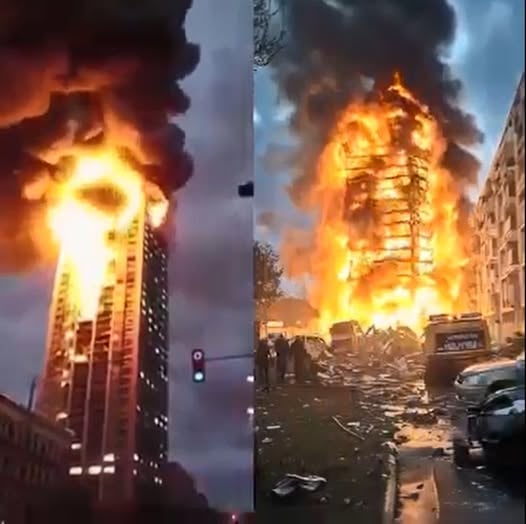
Along the jagged China–Myanmar border, the earth has shifted in ways that will not be undone for decades. What was once a patchwork of quiet villages, terraced hills, and narrow mountain roads is now a fractured landscape marked by landslides, collapsed homes, and deep fissures that cut through fields and memories alike. In parts of Yunnan and northern Shan State, entire neighborhoods have been swallowed by mud and stone, leaving behind only fragments of walls and the outlines of lives that once filled them.
Roads that connected families and markets now twist unnaturally, buckled as if bent by an unseen hand. Power lines sag across ruined streets, silent and lifeless, resembling broken nerves in a body struggling to respond to trauma. In some areas, the smell of wet earth mixes with smoke from small cooking fires as survivors gather in open spaces, afraid to return to buildings that might collapse without warning.
Schoolyards, temples, and empty fields have become temporary sanctuaries. Families huddle together beneath tarps and makeshift tents, clutching blankets, documents, and photographs salvaged from the rubble. These small objects—an ID card, a wedding portrait, a child’s notebook—are all that remain of homes erased in under a minute. At night, fear lingers in the air as aftershocks ripple through the ground, each tremor sending people scrambling into the open, hearts racing as they listen for the deep rumble that could signal another collapse.
The psychological toll is as heavy as the physical destruction. Many survivors speak in hushed voices, their eyes constantly scanning the hillsides above them. Sleep comes in fragments, interrupted by memories of walls shaking, roofs giving way, and the terrifying realization that there was nowhere to run fast enough. Children cling to their parents, startled by every sound, while elders sit quietly, staring at the ruins of places they spent a lifetime building.
Yet amid the devastation, something fragile but powerful is taking shape.
Under temporary floodlights powered by generators, medics work sleepless shifts, treating injuries and preventing infections in conditions far from ideal. Monks, farmers, and local residents dig side by side, hands blistered and clothes soaked with mud, searching for survivors and recovering the dead with solemn care. Volunteers arrive from neighboring towns carrying sacks of rice, bottled water, medicine, fuel, and blankets—small lifelines that mean everything in the first critical days.
Acts of solidarity unfold quietly but constantly. A stranger shares food with a family who has nothing. A farmer offers his tractor to clear debris. A monk murmurs prayers as bodies are carried out, giving dignity to lives lost amid chaos. In these moments, grief and compassion exist side by side, neither overpowering the other.
Governments on both sides of the border have promised aid, assessments, and long-term reconstruction. Officials speak of rebuilding roads, restoring power, and stabilizing hillsides. But for those who lost everything in moments, recovery is not measured in plans or announcements—it is measured hour by hour. Each hour brings new questions: Who is still missing? Where will we sleep tonight? How do we begin again when the ground itself feels untrustworthy?
Survivors sift through the rubble not just for belongings, but for proof that their lives mattered before the disaster. They count the living, mourn the dead, and hold onto one shared vow, spoken softly but firmly among the ruins: this is not where their story ends.
The scars along the China–Myanmar border will remain visible for years. But so, too, will the resilience of the people who refuse to let loss have the final word.
 admin
admin