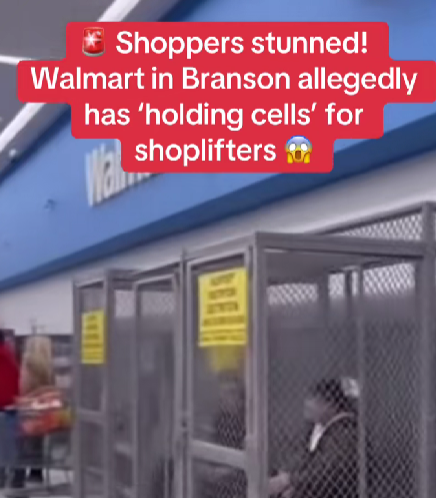
A wave of shock and confusion has swept across social media after a video surfaced allegedly showing what appear to be cage-like “holding areas” outside a Walmart store in Branson. The footage, recorded by a shopper who said they were stunned by what they saw, has quickly gone viral — sparking debate, speculation, and plenty of unanswered questions.
In the clip, several fenced-in structures resembling temporary holding stalls can be seen positioned near the entrance of the store. Large yellow signs are attached to the gates, and the video’s caption claims they are used to detain suspected shoplifters until authorities arrive. While the claim hasn’t been officially confirmed, the visual alone has ignited heavy discussion online.
Many viewers expressed disbelief, with some saying the setup looks more like a storage area, a cart collection point, or a safety enclosure for equipment rather than a space meant for detaining people. Others, however, argued that retail stores have been exploring new ways to protect merchandise amid rising shoplifting concerns — and that such structures, if truly used for detainment, could represent a controversial approach.
What makes the story even more intense is the mix of reactions from locals. Some residents of Branson say they have never seen the cages used for any form of detention and believe the viral claim is exaggerated or misinterpreted. Others say they’ve witnessed loss-prevention teams temporarily escorting individuals outside while waiting for police, though not necessarily inside fenced structures.
Walmart has not released an official statement addressing the video or the rumor, and without confirmation, much of the current conversation remains speculation. However, the buzz continues to grow as people debate whether such measures — if used by any retailer — would be ethical, legal, or even practical.
Legal experts chimed in online, noting that private businesses can legally detain suspected shoplifters for a short period under certain conditions, a rule commonly known as “shopkeeper’s privilege.” However, detainment must follow strict guidelines: it must be reasonable, temporary, and safe. Anything that resembles a jail-like structure could raise questions about liability, safety standards, and customer rights.
Parents commenting on the video expressed concern over how such scenes might affect children or vulnerable shoppers. “Imagine walking into a store and seeing someone behind a cage — even if it’s just for carts,” one commenter wrote. “The visual alone is intense.”
Others criticized the viral reaction itself, pointing out that online rumors often spread faster than facts. A number of users urged people not to jump to conclusions without knowing the store’s official explanation for the structures. “They could be for returned products, propane tanks, lawn equipment, or anything else,” one user said.
Still, the conversation hasn’t died down. The video’s emotional impact — combined with the mysterious appearance of the cages — has kept people intrigued. Whether this turns out to be a misunderstanding or a real retail-security strategy, the clip has definitely sparked one of the most unexpected debates of the week.
For now, shoppers everywhere are asking the same question:
What exactly are those fenced-in structures — and why are they there?
 admin
admin