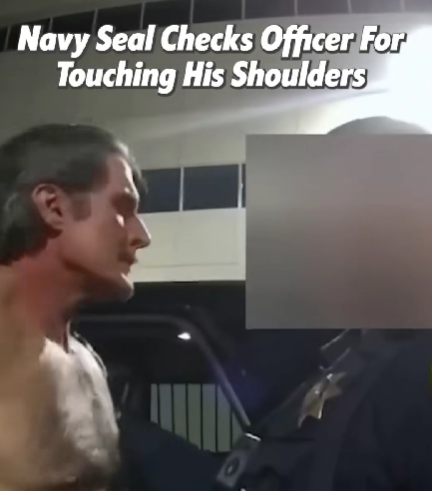
A late-night encounter outside a quiet government building took an unexpected turn when a Navy veteran confronted an officer after what he described as an unnecessary and intrusive shoulder grab. The intense moment, captured on bodycam, quickly went viral as viewers debated who was truly in the wrong — the officer, the veteran, or simply the misunderstanding itself.
The incident began when officers responded to a call about a man pacing near a parked vehicle. When they arrived, they found a shirtless man — later identified as a Navy veteran with years of disciplined training behind him — standing by his car, appearing frustrated but not aggressive. Officers approached calmly, asking him a series of routine questions. Everything seemed standard until one particular moment ignited the tension.
As one officer stepped closer and placed a hand briefly on the veteran’s shoulder, the man instantly stiffened and turned toward him with laser-like focus. His tone sharpened, and his entire posture changed. He didn’t shout, he didn’t threaten, but he made it immediately clear that he did not appreciate being touched without warning. The officer stepped back, surprised by the speed and intensity of the reaction.
Witnesses later explained that the veteran had a long history of working in high-alert environments where unexpected contact meant danger, not reassurance. For him, reflexes honed through years of training kicked in before his mind caught up. He wasn’t trying to intimidate the officer — he was responding the way his body had been conditioned to respond when someone moved into his space suddenly.
The officer, realizing the tension he unintentionally created, tried to calm the situation by stepping back and explaining that the gesture was meant to guide him toward the car door. But by then, the adrenaline was already flowing, and the veteran insisted on maintaining physical distance while continuing the conversation verbally.
Viewers who later watched the footage online had mixed reactions. Some applauded the veteran for standing up for his boundaries, especially given the intensity of his past training. Others felt the officer was simply following standard procedure and meant no harm. Many agreed, however, that the situation revealed a deeper issue: how easily misunderstandings can escalate when communication breaks down, especially during already tense interactions.
What made the moment even more compelling was how it ended. After several minutes of back-and-forth discussion, both men began to relax. The officer acknowledged he should have announced his movement before making contact, and the veteran apologized for reacting more sharply than he intended. By the end of the encounter, they reached a mutual understanding — a rare outcome in a world where conflict too often spirals out of control.
Mental health advocates later pointed out that veterans can experience heightened sensitivity to sudden physical contact, even years after service. Meanwhile, policing experts emphasized the importance of clear communication and consent when physical guidance is involved.
While the footage sparked heated debate, it also highlighted something important: when both sides choose respect over escalation, even tense situations can end with understanding rather than conflict.
 admin
admin