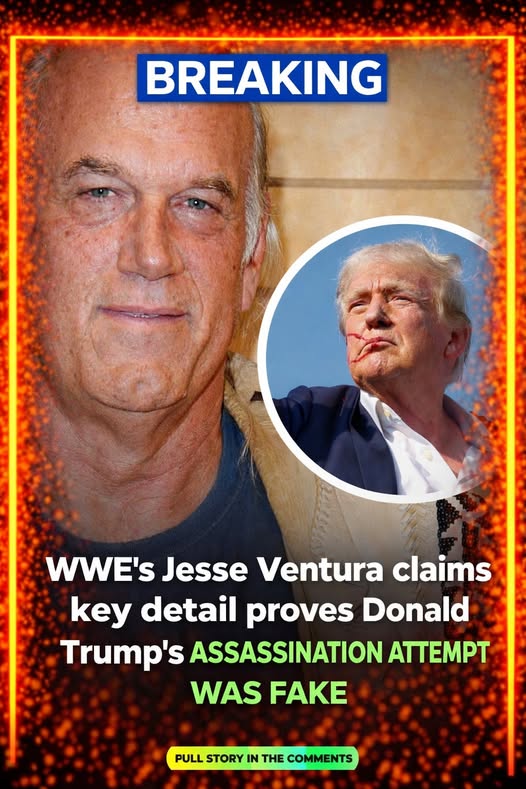
A tense live television moment turned into a national flashpoint when Jesse Ventura confronted Piers Morgan with a controversial claim about Donald Trump’s recent assassination attempt.
Ventura didn’t hesitate.
Looking directly at Morgan, the former wrestler-turned-politician suggested the incident might have resembled a “blade job”—a term from professional wrestling used to describe a staged act where blood is intentionally produced for dramatic effect. In doing so, he implied that what millions saw unfold in real time could have been something other than it appeared.
The reaction in the studio was immediate.
Morgan pushed back strongly, pointing out the seriousness of the event and reminding viewers that a volunteer firefighter lost his life during the rally. The gravity of that fact underscored the danger of reframing the incident as performance or spectacle.
But Ventura did not back down.
Instead, he doubled down—questioning visible evidence, asking where physical signs of injury were, and continuing to cast doubt. His remarks quickly shifted from skepticism about the event to direct criticism of Trump’s character, intensifying the tone of the exchange.
A Moment That Ignited a Wider Reaction

4
Within minutes, clips of the interview began circulating across social media platforms. What followed was a rapid and polarized reaction.
Some viewers were shocked by Ventura’s comments, calling them inappropriate and dismissive of a serious and deadly event. Others, already skeptical of political narratives, amplified his claims—fueling a wave of speculation, edited images, and competing interpretations.
Fact-checkers and journalists responded quickly, attempting to clarify what was known, what had been confirmed, and what remained misinformation. But in the fast-moving digital landscape, corrections often struggle to keep pace with viral claims.
When Reality and Narrative Collide
This moment highlights a growing challenge in modern media: the blurred line between reality and perception.
Events that once would have been treated as unquestionably real are now, in some circles, immediately questioned, reframed, or even dismissed. The speed of information—and misinformation—means that narratives form almost instantly, often before full details are confirmed.
Ventura’s comments didn’t just question a single event. They tapped into a broader environment where trust in institutions, media, and official accounts is already fragile.
The Impact of High-Profile Statements
When public figures speak, especially on live television, their words carry weight. Statements like these can shape conversations far beyond the initial moment—especially when they touch on sensitive topics like violence, loss, and national leadership.
In this case, the controversy wasn’t only about what was said, but about how it was said—and what it implied.
For many, comparing a real-world incident involving injury and loss of life to a staged wrestling act crossed a line. For others, it reflected a deeper skepticism that has become more common in public discourse.
A Divided Response
The aftermath has revealed a deeply divided audience.
- Some emphasize the importance of respecting verified facts and those affected by the event
- Others focus on questioning narratives and demanding transparency
Between these positions lies a complex and often tense conversation about truth, trust, and responsibility.
The Bigger Picture
Moments like this are no longer isolated.
They are part of a broader shift in how people consume and interpret information. In an era where anyone can comment, share, and amplify content instantly, the boundary between informed discussion and speculation can quickly disappear.
The result is a landscape where even the most serious events can become contested narratives.
Final Thought
Ventura’s remarks didn’t just create controversy—they exposed something deeper.
A reality where:
- Facts are questioned in real time
- Narratives compete for attention
- And public trust is constantly tested
In that environment, even events witnessed live can be reinterpreted within minutes.
And once that happens, the conversation is no longer just about what occurred—
It’s about what people choose to believe.
 admin
admin