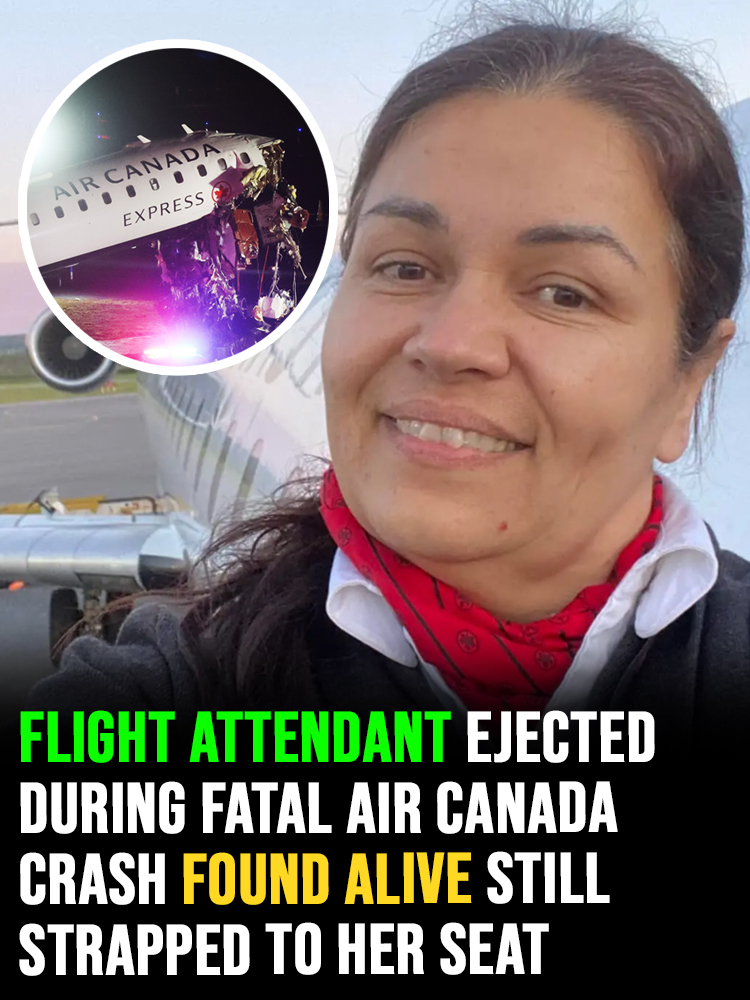
The collision on the runway at LaGuardia Airport unfolded with a violence that few inside the cabin could fully comprehend in the moment. What should have been a routine operation turned catastrophic in seconds—metal tearing against metal, the deafening roar of impact, and then the sickening silence that followed. For those on board Air Canada Jazz Flight 8646, time fractured into chaos.
In the cockpit, there was no chance. The force of the crash obliterated the front section of the aircraft, claiming the lives of both pilots instantly. Behind them, the cabin became a storm of flying debris, smoke, and panic. Passengers were thrown against their restraints, overhead bins burst open, and the sharp scent of burning fuel filled the air. It was the kind of accident investigators later described as “unsurvivable” in the forward sections of the plane.
And yet, improbably, there was Solange Tremblay.
A 26-year veteran flight attendant, Tremblay had taken her assigned jump seat near the front of the aircraft—one of the most dangerous positions in a crash of this nature. These seats, however, are not ordinary. Designed with reinforced frames and harness systems, they are engineered to withstand immense forces so that crew members can remain conscious and capable of directing evacuations. In theory, they are among the safest seats on a plane—if the surrounding structure holds.
This time, it didn’t.
At the moment of impact, Tremblay’s jump seat tore free from its mounting. Still strapped in, she was violently ejected from the aircraft, propelled more than 100 meters down the runway. It was not a controlled escape or anything resembling survival instinct—it was pure physics, brutal and indiscriminate.
When first responders arrived, they expected fatalities in that zone. Instead, they found something almost impossible: a woman, alone on the tarmac, still breathing.
Tremblay’s injuries were severe. Multiple fractures, including a shattered leg, internal trauma, and extensive bruising told the story of the forces her body had endured. Yet crucially, she was alive—and conscious enough to be rushed into emergency care. Surgeons would later work for hours to stabilize her, piecing together bones and managing internal damage in a race against time.
For her daughter, Sarah, there was only one word that made sense: miracle.
Investigators, bound to evidence and physics, chose a different term: “extraordinary survivability.” Their analysis pointed to a combination of factors that aligned in ways rarely seen. The reinforced jump seat likely absorbed a critical portion of the impact energy before detaching. The trajectory of her ejection may have spared her from secondary explosions or structural collapse. Even the surface she landed on—relatively flat runway rather than wreckage—could have reduced fatal injury.
Still, none of those explanations fully resolve the central question: why her?
Aviation accidents are often studied in terms of systems and probabilities, not individuals. Yet cases like Tremblay’s resist clean categorization. They exist at the edge of engineering and chance, where design, timing, and sheer luck intersect in ways that defy expectation.
In the aftermath, much attention was rightly focused on the loss of the pilots and the injuries sustained by passengers. But Tremblay’s survival became a different kind of focal point—not just for investigators, but for the aviation community as a whole. It underscored the importance of safety design, even in scenarios where survival seems impossible. More than that, it served as a reminder that resilience—human and mechanical—can manifest in ways no one predicts.
Today, her story stands as both a testament and a question mark. A testament to the engineers who design for worst-case scenarios, and a question that lingers quietly: in the midst of disaster, what makes the difference between life and death?
For one flight attendant on a shattered runway, that difference was measured in fractions of a second—and a seat that refused to fail completely.
 admin
admin