In the digital age, grief often travels at the speed of a scroll.
One image can pierce through noise, politics, and distance — and suddenly the world is paying attention.
For thousands across Canada and far beyond, that image is Maya Gebala.
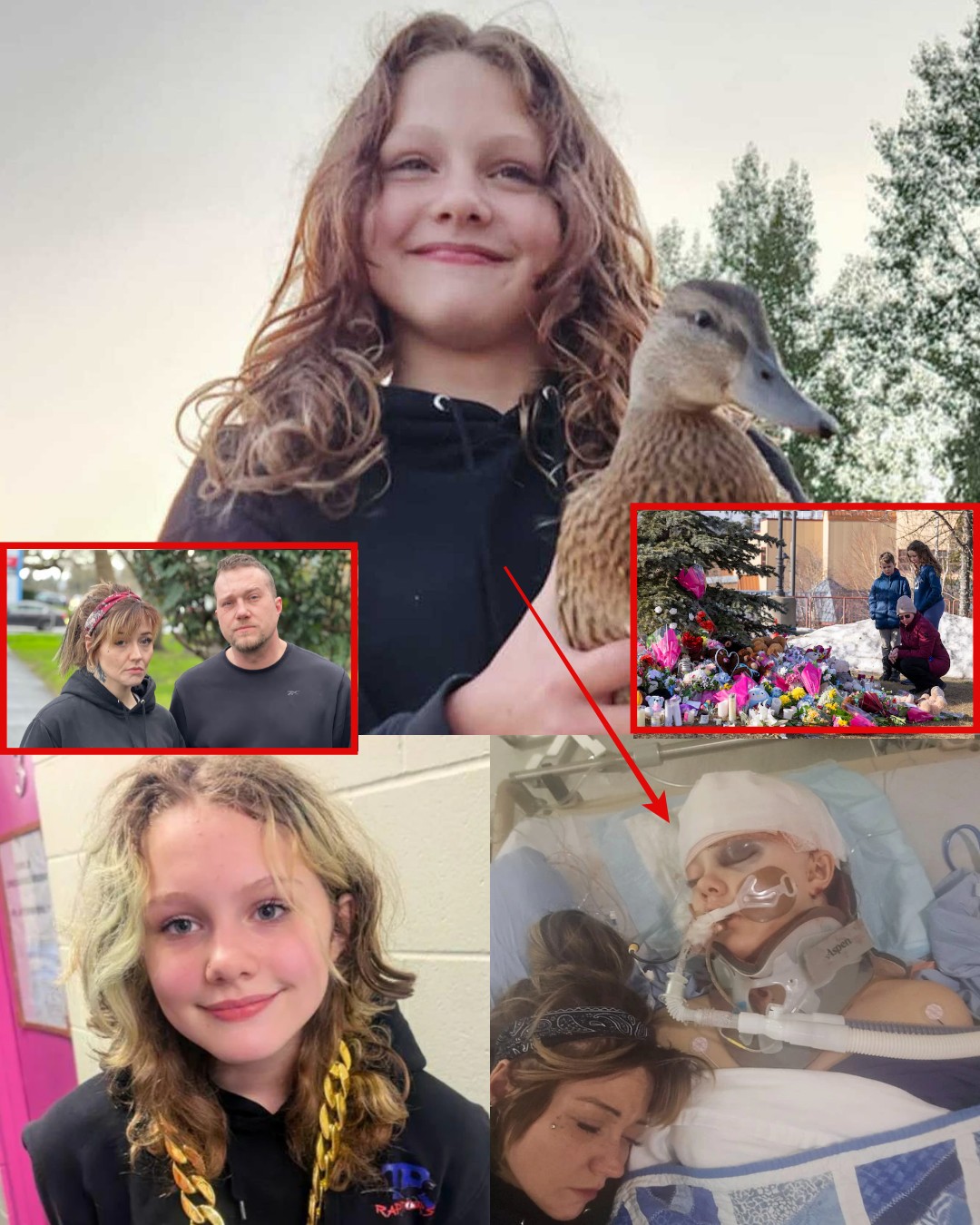
On one side of the now-viral post is a bright, determined 12-year-old girl in full hockey gear, her eyes shining behind the cage of her helmet, her smile wide with confidence and youth. On the other side is the unbearable contrast: the same child lying in a hospital bed, her face bruised and bandaged, tubes and machines helping her breathe.
Between those two photos lies a single day that changed everything.
On February 10, what began as an ordinary school day ended in horror when gunfire erupted inside Tumbler Ridge Secondary School. Eight lives were lost in the attack — students, an educator, and members of the shooter’s own family. The small northern community was left shattered, its sense of safety fractured in a matter of minutes.
Maya survived.
But survival came at a cost.
She was airlifted in critical condition to B.C. Children’s Hospital after suffering multiple gunshot wounds to her head and neck. Surgeons worked through the night. Doctors prepared her parents for the worst. For the first 48 hours, the prognosis was devastatingly uncertain.
Her mother, Cia Edmonds, and father, David Gebala, were told there might be nothing left to do but sit beside their daughter and say goodbye.
Instead, they waited.
On Thursday, against staggering odds, Maya began to show signs of response. She moved her left hand. She moved her leg. She coughed. Tiny actions — barely perceptible to an outsider — but to her parents, they were seismic.
“She’s a hockey player,” her father said, standing outside the hospital, exhaustion lining his face. “She taught herself to walk on stilts. She’s way too stubborn to let this win.”
Doctors have since reduced her sedation, allowing her to remain on pain management while closely monitoring brain activity. Her condition remains fragile. Gunshot wounds to the head and neck carry profound risks — long-term cognitive impairment, neurological complications, months or years of rehabilitation.
But she is here.
She is breathing.
And in a town that feels broken, that is enough to call it hope.
Yet Maya’s survival is not the only reason her story has captured hearts.
In the midst of unspeakable trauma, her mother has chosen words few expected.
Instead of directing anger outward, Cia Edmonds has publicly urged compassion — even for the mother of the shooter. The two women had known each other. Edmonds had once babysat the young man who would later carry out the attack.
She described his mother as someone who tried to get help, who sought mental health support repeatedly, who struggled within a system that did not always respond.
“It’s about mental health. It’s about a lack of resources,” Edmonds said in an interview, her voice steady despite everything she has endured. “I truly believe she did everything she could. I weep for her, too.”
In a climate where outrage often dominates headlines, that empathy has resonated deeply.
People have called it extraordinary.
Others have called it grace.
And perhaps it is both.
As news of Maya’s condition spread, strangers began responding in the only way they could: by giving.
A fundraising campaign initially created to help with travel and immediate medical expenses quickly surpassed its first goal. Then it doubled. Then it multiplied again. Within days, donations surged past $500,000.
Contributions poured in from across Canada, the United States, Europe, Australia, and Asia. Many donors referenced the same thing — the hockey helmet photo. They saw in Maya not just a victim, but their own child. Their niece. Their neighbor.
“Seeing that little girl in her hockey gear reminds us all of our own children’s innocence,” one donor wrote. “We’re praying for her.”
The funds are intended to support what lies ahead: long-term neurological care, rehabilitation, therapy, and the reality that her parents will remain at her bedside instead of returning to work anytime soon.
Because the road ahead is long.
Even in the most optimistic scenarios, recovery from traumatic brain injury is measured in months and years, not days. There will be physical therapy sessions. Speech therapy appointments. Follow-up scans. Moments of frustration. Moments of exhaustion.
And hopefully, moments of triumph.
For now, Maya’s parents are living minute to minute.
“I just want her to say ‘Mama’ one time,” Edmonds said through tears. “Just one time
The shooting has reignited conversations about school safety and mental health support across the country. Lawmakers and community leaders are already debating policy and prevention.
But for this family, politics are distant noise.
Behind the hospital curtain, none of that matters.
What matters is a 12-year-old girl who once spent her afternoons practicing slap shots and working on science projects. A girl who should be worrying about homework and hockey games — not brain swelling and life support.
In Tumbler Ridge, candlelight vigils have flickered against the cold northern air. Classrooms sit quieter. Hallways echo differently. Parents hold their children a little longer at drop-off.
Tragedy has carved a wound into the heart of the community.
But in the face of that wound, Maya has become something unexpected: a symbol of resilience.
Not because she chose this fight.
But because she is still fighting.
Her story is not over. It is suspended in uncertainty, balanced between fear and faith. Doctors remain cautious. Prognoses remain guarded. But hope, however fragile, has taken root.
The image that first broke hearts now carries a different weight.
The hockey helmet is no longer just a symbol of childhood joy. It is a reminder of grit. Of stubbornness. Of a young athlete who refuses — at least so far — to let darkness win.
Half a million dollars in donations cannot erase what happened.
Compassion cannot undo violence.
But together, they form something powerful: a community — and a world — refusing to look away.
As Maya continues her fight behind hospital walls, strangers whisper her name in prayer. Parents explain her story to their children. And a small town holds its breath, waiting for the next movement, the next word, the next sign of life.
In a year already marked by sorrow, Maya Gebala has become the face of resilience.
And the world is watching — not for tragedy this time, but for recovery.
 admin
admin