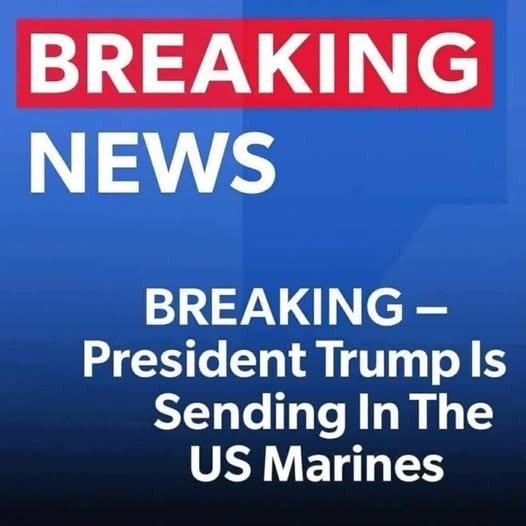
In a move that has sparked intense debate across the United States, the U.S. military has confirmed the deployment of about 200 Marines to Florida to assist U.S. Immigration and Customs Enforcement (ICE) with ongoing immigration operations. While military officials emphasize that these Marines will perform non-law enforcement duties, critics say the optics raise serious questions about the role of active military personnel in domestic matters.
The deployment was announced by U.S. Northern Command (USNORTHCOM) and represents the first wave of support to ICE requested by the Department of Homeland Security (DHS). According to the Pentagon’s announcement, the Marines are being mobilized to provide administrative and logistical support rather than participate in enforcement actions against migrants.
Under the plan, these service members — drawn from the Marine Wing Support Squadron 272 based in North Carolina — will carry out tasks such as managing records, helping process documentation, and offering logistical assistance in facilities that house immigrants. Northern Command has made it clear that the Marines are prohibited from direct contact with individuals in ICE custody or involvement in law enforcement activities.
The initiative is part of a broader effort approved in May by Defense Secretary Pete Hegseth, which could eventually mobilize up to 700 military personnel, including active duty, National Guard, and reserve forces, to support ICE operations not only in Florida but also in Louisiana and Texas — states with high numbers of immigration detainees.
Proponents of the deployment, particularly conservative lawmakers and homeland security officials, say the additional personnel will help streamline administrative work and free up ICE agents to focus on enforcement priorities such as deportation and border security. They argue that under current manpower strains, logistical bottlenecks hinder effective processing and contribute to backlogs in detention centers.
However, not everyone sees the move in a positive light. Critics across the political spectrum have raised concerns about the use of active military forces in support of domestic immigration activities — even when those duties are labeled as non-law enforcement. The involvement of Marines in uniform alongside ICE agents has ignited debate about the appropriate boundary between military support and civilian law enforcement, especially given historical limits on domestic troop use under laws like the Posse Comitatus Act.
Some civil liberties groups and immigration advocates argue that the deployment sends a chilling message to immigrant communities, potentially deterring individuals from seeking medical care, education, or reporting crimes due to fears of increased militarization. These critics point out that even if Marines are not performing enforcement duties, their presence in detention centers and logistical operations could blur lines of accountability and community trust.
At the same time, supporters emphasize that the decision does not authorize Marines to make arrests or directly interact with detainees, and that the mission is designed to stay within the confines of administrative assistance. Pentagon directives specifically disallow direct involvement in custody, enforcement, or the physical handling of detainees, underlining that the troops will be used to help with clerical and logistical needs rather than policing.
Beyond Florida, future deployments to ICE facilities in Louisiana and Texas are expected to follow similar roles, focusing on helping with case management duties, data processing, and support tasks that can otherwise slow down immigration operations.
The deployment comes amid broader immigration policy debates and heightened political tension over border security, deportation priorities, and the treatment of migrants entering or staying in the U.S. Many observers see the Marine deployment as part of an expanded federal strategy to bolster immigration enforcement capabilities, even as legal and ethical questions continue to swirl around the involvement of military personnel in domestic contexts.
What remains clear is that the announcement has ignited a national conversation about the balance between security and civil liberties, and about how immigration challenges should be managed in a democratic society where the role of the military at home is sharply contested.
If you’d like, I can also draft a timeline of events, a pro-and-con breakdown, or a shorter news alert version of this story.
 admin
admin