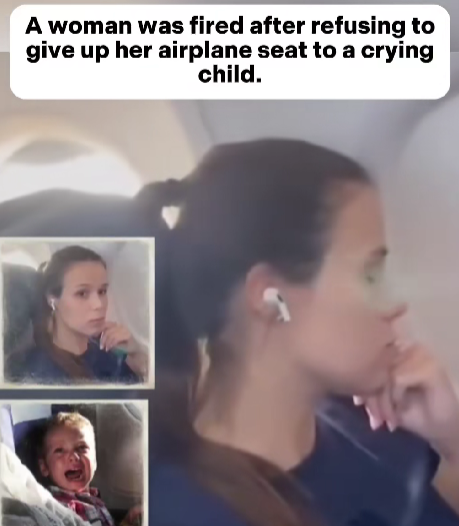
What began as an uncomfortable flight turned into a life-changing controversy after a woman was reportedly fired from her job following an incident aboard an airplane. Her decision? She refused to give up her assigned seat to accommodate a crying child — a choice that has since ignited a fierce debate about boundaries, entitlement, and how far personal responsibility should go.
According to accounts circulating online, the woman had boarded the flight, taken her assigned seat, and settled in for the journey wearing headphones. Nearby, a young child became visibly upset, crying loudly as the plane prepared for departure. The child’s caregiver allegedly asked the woman to switch seats to help calm the situation.
She said no.
What might have ended as a tense but private moment instead spiraled into a viral controversy. Other passengers reportedly weighed in, some siding with the caregiver, others defending the woman’s right to keep the seat she paid for. The atmosphere inside the cabin grew uncomfortable, with judgment felt on all sides.
The woman later explained that she had chosen her seat intentionally and did not feel responsible for solving someone else’s travel challenges. “I paid for my seat,” she reportedly said. “I didn’t do anything wrong.” Many online agreed, arguing that accommodating a crying child is not a legal or moral obligation for fellow passengers.
But the story didn’t end when the plane landed.
Footage and photos from the flight began circulating on social media, quickly drawing millions of views. As the clip spread, internet users dissected the moment, assigning blame, projecting motives, and turning a private decision into a public spectacle. Before long, the woman’s identity was allegedly discovered.
Shortly after, reports emerged that she had been terminated from her job.
Her employer has not publicly released full details, but sources suggest the company believed the viral incident reflected poorly on its image. That revelation sparked a second wave of outrage — this time focused on whether employers should punish workers for behavior that occurs outside the workplace.
Supporters of the woman argue that she was unfairly targeted. “Since when does refusing to give up your seat become a fireable offense?” one commenter asked. Others warned that this sets a dangerous precedent where viral outrage replaces due process.
On the other side, critics say compassion matters, especially in shared spaces like airplanes. They argue that while she may have had the right to keep her seat, showing flexibility could have prevented the situation from escalating. To them, the issue isn’t legality — it’s empathy.
Experts note that air travel is already stressful, particularly for families with young children. Crying can be unavoidable, and caregivers often rely on understanding from those around them. At the same time, specialists emphasize that managing a child’s comfort ultimately falls on the caregiver — not strangers.
The incident has reopened a broader conversation about “public shaming” culture. With smartphones everywhere, moments of disagreement can instantly become viral narratives — often without full context. Once that happens, reputations, jobs, and mental health can be affected overnight.
Employment advocates warn that companies reacting to online backlash risk undermining trust with employees. “If workers believe a viral clip can cost them their livelihood, it creates fear and silence,” one expert said.
For the woman involved, the consequences appear very real. A single decision during a flight — one many people make every day — now defines her publicly. Whether she was right or wrong is still being argued. What’s not disputed is the speed at which judgment arrived.
In the end, this story isn’t just about a crying child or an airplane seat. It’s about where society draws the line between personal choice and public expectation — and how quickly that line can disappear once the internet gets involved.
One flight. One refusal. And a reminder that in the age of viral moments, even ordinary decisions can carry extraordinary consequences.
 admin
admin