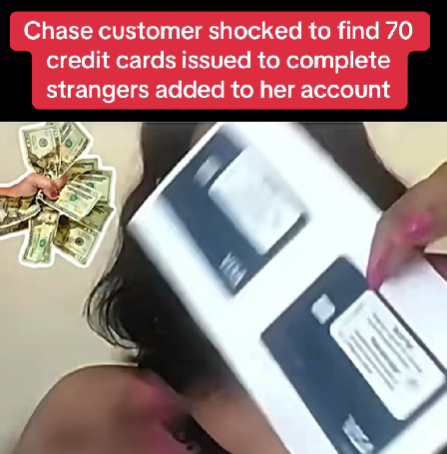
A Chase Bank customer is speaking out after discovering 70 credit cards—yes, seventy—had been issued under her account and mailed to her home, even though she had never requested them and didn’t recognize the names on any of them. The bizarre and alarming mix-up, now making waves across social media, has raised serious concerns about fraud, identity protection, and how such an enormous error could possibly happen in one of the country’s largest banking institutions.
The viral clip begins with the woman holding up a thick stack of envelopes, each one containing a newly issued credit card. She flips through them on camera, showing that every card is addressed to a different person—none of whom she has ever heard of. “These are not my cards,” she says in disbelief. “I don’t know a single name on any of them.”
According to her, the cards started arriving unexpectedly, one after another, filling her mailbox day after day. At first, she assumed it was a simple clerical error—maybe one or two cards sent to the wrong address. But when the number kept growing and reached 70, she realized something far stranger was happening.
Cybersecurity experts who viewed the video say this kind of incident is highly unusual. While cases of identity theft are common, receiving dozens of cards tied to unknown individuals suggests a possible system glitch, a fraudulent mass application scheme, or a mailing override error inside the bank’s processing system. They note that such a large volume of erroneous cards could mean the customer’s address was mistakenly assigned as a central mailing point for multiple accounts.
The woman quickly contacted Chase Bank, expecting immediate answers—but according to her, customer service was just as confused as she was. Representatives reportedly told her that the cards were indeed linked to her address but did not match her identity. They advised her not to activate any of them, not to dispose of them, and to wait while fraud investigators took over the case.
Financial analysts online emphasize that while the situation is shocking, the woman did the right thing by reporting the issue immediately. They warn that receiving credit cards for strangers is a major red flag—potentially signaling identity theft rings, application hijacks, or attempts to exploit loopholes in card issuance systems. In some cases, scammers use real customer accounts to mask fraudulent activity.
The story has sparked widespread conversation, with viewers expressing everything from sympathy to outrage. Many commented that such an oversight could have put the woman’s credit history, financial stability, or personal identity at risk. Others questioned how many other customers might be affected without even knowing it.
Chase Bank, when contacted by media outlets, reportedly stated that they are investigating the issue to determine whether it was caused by fraud, an internal system error, or a breakdown in identity verification protocols.
Meanwhile, the woman is urging others to monitor their mail and bank accounts closely. “If something looks off—even a little—don’t ignore it,” she says.
Her experience serves as a powerful reminder that in today’s digital world, financial vigilance isn’t optional. Whether it’s one unexpected card or seventy, unusual activity should always be taken seriously.
 admin
admin